Episode Transcript
[00:00:22] Let's talk cars, shall we?
[00:00:24] It's a good time to talk about cars.
[00:00:27] Cars. It's sad.
[00:00:29] As a technologist, I am. It's sad to see the decline of cars. It's sad to see cars reduced to nothing more than an afterthought for people from a time in the distant past where the car was a signature, it was a picture, it was the emulation of a person. You, you strived to have a vehicle that you could be proud of. You strive to drive a car that was part of. Part of who you were.
[00:00:59] We had cars, you know, manual transmission cars and coupes and convertibles and long cars that took an hour to make a turn.
[00:01:10] You know, I'm not suggesting that we go back to an era of crank windows. I'm saying that the styling, everything's lost. Everybody, every car maker is now trying to make the cars look futuristic for no real reason, of course. The light put out from the headlamps is now garbage.
[00:01:29] And we had a rush to EVs, which we weren't ready for. Which I've said a multiple times and if you knew, welcome. But over time I've said that we were not ready for EVs. I've said it repeatedly. This is the truth. We were not ready for EVs. We're still not ready for EVs. Our grid is not prepared for EVs.
[00:01:45] Case in point, this morning at 8:15am, the power goes out. It was out all the way till 3 2.58pm, an extended outage. What was the cause? The cause was a tree.
[00:02:03] Because at about 5:20 ish am in the morning, the sky was a eerie shade of orange.
[00:02:14] The wind started picking up.
[00:02:17] It almost felt like hurricane winds. Hurricane force winds. They weren't, but it almost felt like it. They were strong.
[00:02:26] Sky was orange.
[00:02:27] Then the rain comes.
[00:02:30] Initially it's light rain, but because of the wind whipping, it made the rain seem stronger than what it was. And then the rain picked up and then was torrential.
[00:02:41] All of a sudden we're close to flooding. Now, in certain areas they had actual flooding events and things. So I do not want to compare those with what we experienced. This only lasted like five minutes.
[00:02:55] But the problem is that because the winds are so strong and because for reasons I cannot understand, they refused to bury the power lines out here now where we used to live.
[00:03:07] The power was. It was buried. There's a green box and the electrical is underground. I don't recall ever having a power outage. I'm sure there probably was some, but I don't recall having. So it must have been so infrequent as to not be substantial yet here.
[00:03:24] So I've been here now one month and.
[00:03:28] Or one year, rather, one year and two months, one year and two months in, and I'm pretty sure there's been at least, so minimum, at least three power outages, substantial power outages. There also have been those unsubstantial power outages. You know, they come and go and it's only a couple of minutes or hour, but at least three that I can recollect, substantial power outages. Now, I consider that a high number.
[00:04:00] There's a lot of trees in this area.
[00:04:04] It's a very windy place.
[00:04:06] It's a very.
[00:04:08] It's not friendly to overhead power lines.
[00:04:12] Yet they, for whatever reason, refused to bury the power lines.
[00:04:16] So with grids getting knocked out, and then of course, the electric rates are a ripoff because they claim that the cost of delivering the electricity is sky high, because they don't believe in renewables out here.
[00:04:30] I'm telling all that because when we rush to EVs, there's an assumption that we're going to be ready to do it, that we're ready. We've got the energy, we've got the capacity, we have the ability to provide it to people in an expeditious manner without killing the grid.
[00:04:48] Yet we can't even keep our houses powered.
[00:04:51] So how do we expect to add significant strain on the grid with this rush to EVs? It didn't make any sense, but that's what we did. We rushed to EVs. You might not have known what was the driver, no pun intended, behind the rush to EVs. The driver to the rush behind EVs was the government.
[00:05:12] Years and years ago, this didn't start with Obama, believe it or not, but years and years ago, there was a belief that climate was needing to be a priority.
[00:05:22] And so the environment, the epa, becomes a thing.
[00:05:28] And what the government does when they want to encourage change of a process is they will provide tax incentives.
[00:05:36] They'll provide tax incentives to the companies, tax incentives to the consumers. Because what they're trying to do is steer behavior, no pun intended.
[00:05:46] They want you to do what they want you to do, and they use the incentives as their way to convince you to do it their way.
[00:05:54] If you have gone shopping for a car anytime in the past 10 years or so and you considered either a hybrid or electric vehicle, you would have been told about credits, tax credits, and some of them, it's like 7,500 bucks.
[00:06:12] These are the tax incentives that are designed to entice consumers to steer towards electric vehicles. These incentives, as well as other credits and incentives given to the auto manufacturers enticed those manufacturers to essentially, I would bear, say, abandon gas vehicles and go all in on EVs, which we weren't ready for.
[00:06:37] Well, recent information has come out saying that those manufacturers are basically struggling.
[00:06:43] There's multiple reasons behind the struggle and I think people don't understand just how bad this is. But a lot of consumers who went in on EVs didn't do their due diligence before doing so. A lot of consumers bought into the hype. Some consumers were simply, you know, swayed by the Greta Thunbergs of the world. The, the atmosphere, the climate, the environment. We have to do something. That was their motivation.
[00:07:13] I don't know if anybody's paying attention or not, but the prices of EVs are sky high. I would dare say even a ripoff, they just are. And part of this flaw in strategy, in the rush to EVs, it allowed the auto manufacturers to skyrocket prices because they have no choice. The battery in most EVs is the most expensive component. This then replaced on the gas side the most expensive components such as the catalytic converter, the engine block. Right.
[00:07:49] Combustion engine. So all they did is increase the price. Then they made it worse by adding a bunch of technology that people don't really need inside the car itself. Now it's all a bunch of screens, people getting away from knobs. And all that's going to do is increase safety problems. Well, to combat that, they rush towards auto driving and garbage. And of course we see tons of accidents because people turn on that auto driving.
[00:08:16] It was given to them. So they're like, why not let's just turn on the auto driving and risk some lives. And that's what we have. We have a bunch of over technology cars. We have a bunch of garbage on the road designed to appeal to the, the younger folks, you know, the ones that can't really afford it.
[00:08:32] That's the game, right? The people who are older, who don't care about such things have less options. And so they're forced to do something when their current car dies. The collusion continues because then the governments impose stupid standards for emissions and such that force people to, if they don't like the new cars, they have to spend a lot of money keeping their current car running.
[00:08:58] If they do get a new car, they're getting ripped off on the new Car, no matter what, they're going to get your money out of it. Then again, the I argue the government, governments plural, are in collusion with the auto manufacturers to force you to get into the new cars. This is the incentives for the businesses.
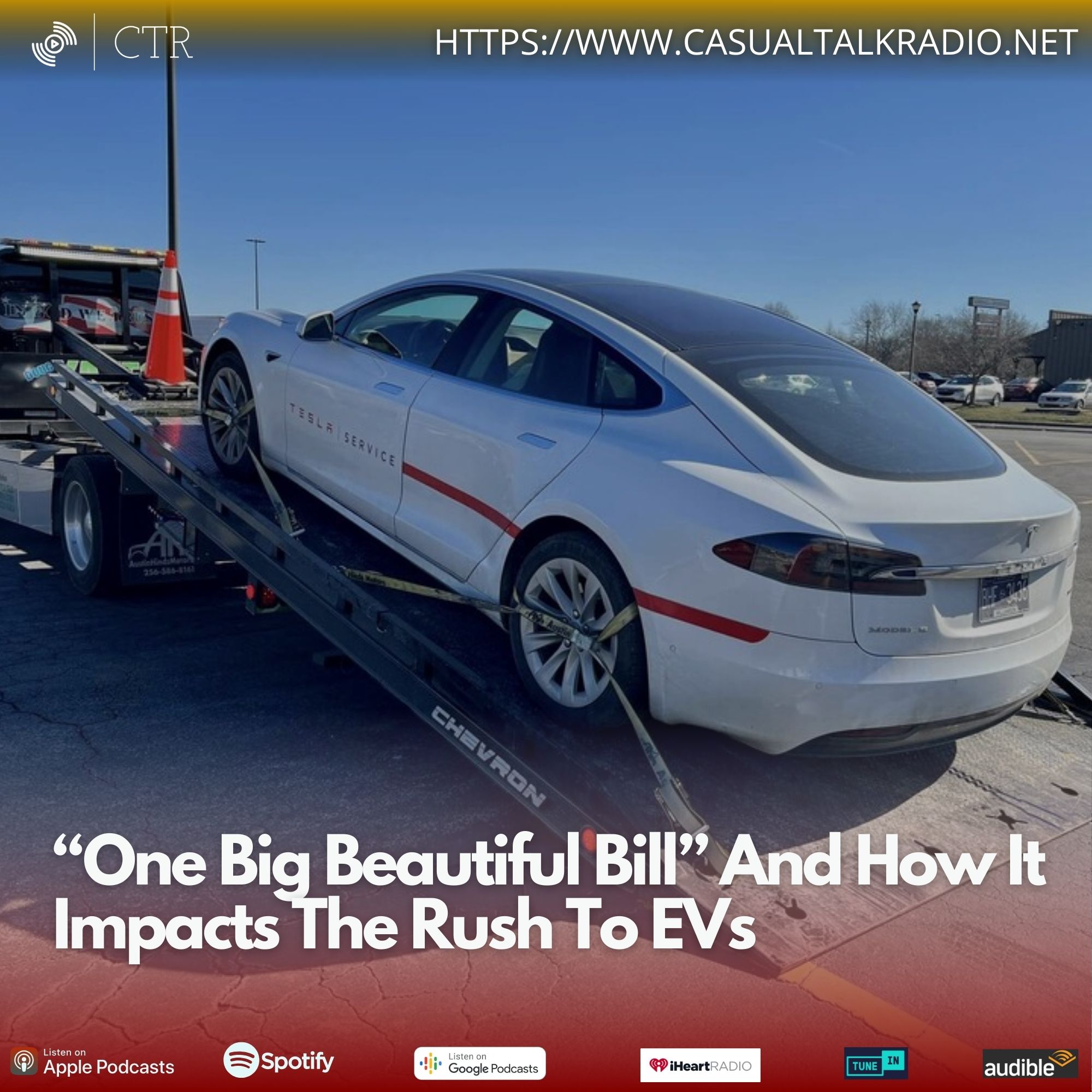
[00:09:17] They're doing everything they can to try to incentivize this way of doing. Donald Trump in the most recent one big beautiful bill passed a bunch of legislation that's intent was to roll back a lot of these standards that were imposed, such as minimum mileage standards, emissions standards, all of these things that were being forced down by first the Obama administration, then later the Biden administration.
[00:09:43] The one big beautiful bill was designed to roll a lot of that back.
[00:09:48] Now separate from that. So now there's no more of these. The tax credits are going to go away. Clean energy credits are going to go away.
[00:09:56] All of these incentives are going to diminish.
[00:09:59] The auto manufacturers still believe that electric vehicles are the future, which they're wrong.
[00:10:05] At least in the short term. They're wrong. They flat out are wrong. Hybrids should be where we're at now. Hybrids are more sustainable, hybrids are more logical. Hybrids are the logical progression. If we just measure how long it took to even get to gas vehicles, it didn't happen overnight, it didn't happen in 10 years.
[00:10:25] So it was unrealistic to expect a leap to EVs. We never gave hybrids a chance. Most of the auto manufacturers might have had one and then basically gave up.
[00:10:34] Chevy with the Volt had arguably something and they basically just gave up. Well, why?
[00:10:40] Because they were focused too much on style and not enough on the, you know, the robustness of the vehicle. The Prius, Toyota I think did a decent job on the performance side, but it was a horrible looking vehicle and nobody seemed to get it right.
[00:10:56] Nissan, when they did have hybrids, was right there with the Ultima hybrid. I think they did a really good job and then they quit. They just gave up.
[00:11:04] Ford, I think I have a Ford Fusion Energy. I think the hybrids a decent car, but it's not what it could be. The Fusion Energy is an amazing car when you take care of it.
[00:11:16] I'll get to some points on that. But they gave up. They quit because there was a number of recalls. Well, the recalls were because they went short. They cheaped, cheaped out on a lot of the parts. Many of the manufacturers did not go all in like they're doing with EVs. They're putting more energy on EVs and trucks, ironically. Well, look at how many recalls there are on trucks. Nowadays look at how many recalls there are on the EVs nowadays look at how many accidents there are from Tesla, which is the most popular EV that there is.
[00:11:45] Surveys were taken and it turns out that people indeed do want gas vehicles. Because they didn't do their due diligence going in. They didn't realize about range anxiety, which is a real thing. The idea that they're always worried that they can't go far enough.
[00:11:59] They are now resonating with the obvious, which is yes, it does take hours minimum one to charge your car from empty. If it's an ev, you can't just go like the gas station where you're in and out in five minutes. It doesn't work that way.
[00:12:14] So that affects your trip, your travel, your trip plans and everything else. And it's not like charging stations are everywhere. People make that claim. That's not true. I guarantee you there are many parts of Nevada you will not see a charging station. I know this. I drove through the broad span of Nevada. Pretty much every city in Nevada I touched at least once. And there are charging stations are the exception to the rule. I actually have an infamous photo where I'm out in the middle of nowhere. There is no charging station. If your car broke down your ev, you're toast.
[00:12:46] And because people were stupid enough to get rid of regular phones, if you're. And there's no cell signal out there because it was near Area 51, you're toast. You're going to foot it and it's hot.
[00:12:57] So the, the reality is that people are understanding. Well, this wasn't that good of an idea because you can't get the range that you might expect. Teslas get decent range, but Teslas are egregiously expensive.
[00:13:08] Some of The Tesla's like 40 to 60 grand. People should not have to pay a quarter of a mortgage to be able to get a car. That's a, that's a joke. You know, at a time you could get a brand new car, gas car, and it was 10,000 bucks. That was the reality of getting, you know, the nice starter car for your kid after they graduate high school. We're long past that now.
[00:13:28] So I again my Fusion Energy, I think it's, it's smoothest driving car didn't start that way about it. Used. I had bought in a regular hybrid before Aston I called him and I sold it for a different car, which I regret. But at the time it seemed like it made sense because it was less miles. Plus I was trying to refinance it and long story, but it was a mistake for me to do that. And then Covid hit and then that car, I didn't want to pay a monthly payment because there was no reason because I was not making any money.
[00:13:59] So that car I gave back to the bank, I literally gave it back to him. And then I ended up buying the car that I have now which is an energy.
[00:14:07] The car that I gave back was an energy but it wasn't the high end energy, it was just a base model energy. This is the high end energy.
[00:14:14] The car that I have now was misrepresented by CarMax who stated it was in good shape and, and checked out and it was not. And then Ford dealers, I argue collude to take cars off the road by claiming they don't know how to fix things that come up, which isn't true. So then I have a check engine light. I know what it's likely related to. It's likely related to the, the hybrid battery in some ways. And it took multiple site visits and then of course I had to do a renewal of the registration. And this is where the scam, the collusion with the governments come in. Because they don't want to do the emissions check if there's a check engine light. In the old days they stick the little scanner into the tailpipe and just rev the car and be done with it just to make sure there truly is no emissions. Here they're flagging on the check engine light because they believe the only reason a check engine light would be thrown is emissions related.
[00:15:12] The problem is that you could get a false positive in a, in a hybrid vehicle because if there's a problem your car still relies on the hybrid battery to power the sensors. The sensors are what tell the computer whether or not there is a emissions related something. Well the sensor fails, you're going to get a false positive that throws a check engine light. That's not real. It's saying that there's an emissions problem like rich mixture of oxygen etc. And it's not true. It's a false. But the way the government has it set up, they treat it as an instant fail, that you're car is a gross polluter when it's not. And they won't even do the full on test, they'll just refuse to test it.
[00:15:57] And you have to resolve the check engine light. Well, I knew it was the HP battery but the Ford dealers, all four of them claimed they could not replicate the problem. Even the one who I had pick it up. It threw the error right when he was picking up the car, it was right there on the dash. There's no way he could have missed it. And they get it in there and say they couldn't replicate the problem. So I knew it was a scam. I took it and I argued and I escalated it through the government system locally because they were, you know, there's nothing I can do. I'm telling, I'm taking it to places to get tested. They refused to test it. I had one guy say, yeah, you got to drive it for a while. Turns out he was correct.
[00:16:30] But the government is saying, no, he's wrong. He wasn't wrong. I learned that later. Point is, okay, there's nothing I could do. I escalated it to the highest levels of the government. They got a personal contact to work with me and says, take it over here, get it checked out, see if we can get some result. That place took it. They were able to get the error to replicate the first time and then it wouldn't scan.
[00:16:53] When I went to pick it up, she said, okay, I'm going to run it again. And then the check engine light went out. But now, because it threw the check engine light the one time, by policy, they can't run it again. Just a scam. This is the scam that it was. Well, because I know it's HV related, I now have to replace the battery. That battery I'm pretty sure was six grand. Pretty sure to get the battery. Now, it's a brand new battery. But the point is that that shop, Ford dealers claim they could not figure out the problem. They couldn't replicate it. They couldn't get codes. The codes they did get, they were told to disregard. The shop immediately found codes. He said it's obvious anybody who's looking would easily see the coach. Chances are Ford ignored them on purpose because they didn't want to fix the car. They want you to buy a new car. So they're lying to you about it. And I'm calling that out because it's a scam in collusion with the governments who are doing the scam of the check engine light because they're trying to get the cars off the road because they're trying to encourage you to buy a new car. And of course, the manufacturers are only manufacturing EVs and SUVs and garbage. So they're trying to get rid of sedans and all these other vehicles. It's all a big scam. It's all collusion, scams what they're doing.
[00:18:07] But here's the story. You hear me say six grand for the battery and you cringe. The sad thing, I paid pretty sure it was 19 grand. 18, 19 grand for the car.
[00:18:20] It only had 60,000 miles. Right now it only has 66,000 miles. I've barely driven the thing 60,000 miles. It is 10 years old. 11 years old. 11 years old and only has 60,000 miles.
[00:18:34] A car that has that many years on it, if you go by the averages, should be well over the six figures in mileage. But because it was barely driven and the battery had failed at this point, tells me the previous drivers know what they were doing. They mistreated the poor thing. Right again. If a car is taken care of, it works perfectly fine and it'll last you the the duration. So once I replace the battery, it dries like a dream. It's probably the smoothest driving car I've ever driven. And I've driven a lot of cars. And it's outside of maybe the Dodge Charger that I ran at one time, it's this. This guy's the smoothest driving car I've ever had. It's quiet, it's smooth, it just mellow, It's a beautiful car. It just drifts on the road.
[00:19:20] But 18 grand, ish. Six grand. Ish, right. 24 grand.
[00:19:27] But it's still cheaper than the alternative, which is buying a new car.
[00:19:32] It's still cheaper than buying a used car. And it's in better shape than any of the used cars that I could buy because many of them have been mistreated. So the amount of money that you invest goes up because people are mistreating the used cars. And the new cars are garbage, overpriced garbage that's out there that don't have the features I want because they don't have CD players. And I understand people are rushing to Bluetooths and whatnot. I'm not that. No, I'm not doing Apple, I'm not doing CarPlay, none of it. I should be able to take a cd, pop it in there and play it.
[00:20:05] Why does that matter to me? Because I don't want.
[00:20:09] You should not have to take your eyes off the wheel to be able to do that. No, I'm not going to do voice commands. No, I'm not doing this. There's no reason. Pop CD popping in, call it done, flip your track, and then you're good.
[00:20:22] That's what I wanted. None of the other cars have that many cars don't have the power outlets. My car has regular power outlets. 120 volt power outlets in the back.
[00:20:31] Many cars don't have that anymore, but that's a key feature for me. I would never have been able to survive just physically the drive up here without having power outlets to be able to plug stuff in. You can't do the cigarette lighter adapters for everything. You can't do USB for everything. I'm sorry. You have to have a regular power outlet. That helped a lot. It helped significantly, especially when I needed to charge like laptops and stuff. These are things that they're not putting in the modern cars anymore. They're not doing the features that matter. They're putting garbage. Nobody wants, I'm sorry, but nobody with common sense, I should clarify, wants just a big old screen in the front. Just a screen, right? No, no dash, no customizability. The ability to go to the auto shop and take a nice deck that you got, that's got a DVD player and swap it in there. Nobody wants this other stuff. I'm sorry, I get that's what they're pushing, but nobody really wanted it.
[00:21:30] Where am I going with this? Well, people are coming around and I think they understand the mistake of EVs, but it's kind of too late.
[00:21:40] They're out there, they're going to be out there, they're going to be a thing. The auto manufacturer is going to keep making them.
[00:21:46] I'm telling the story that even with buying it used and having to replace the battery, I still spent significantly less money than the alternative.
[00:21:56] And I don't think I made a mistake. I think I made a good decision and I don't regret that decision.
[00:22:01] And I think a lot of people are looking now for those options.
[00:22:06] I would hope that in the next couple of years we get smarter about hybrids because I feel like that's where we should be. I feel like we should not be rushing to EVs. I don't say we should be solely gas, but we certainly should be at hybrid by now.
[00:22:22] If we don't, we don't. But I would hope that that's the inevitable next step because it feels like that's where we should really be.
[00:22:30] If we don't get there and we still push EVs.
[00:22:34] I'm really concerned, concerned for the. Because they'll say tariffs are the impacts. It's not tariffs in that regard, it's we. Our grid's not ready for it. They're pricing people out. They're pricing out the low income people. Right. So you talk about it's like a form of auto manufacturer redlining. If you think about it, you are pricing out. You know what you're doing? You're pricing people out is what you're doing. They can't afford that. And then they're in collusion with banks and their own financial companies, and they get a kickback to redirect people to overpriced loans that they can't afford, and then those are in collusion with the tow companies.
[00:23:12] It's all a big scam.
[00:23:14] And I would like to see a world back where we can buy a car fresh, new, for ten grand. It doesn't need to be fancy. I'm saying that for that kid that you want to give a car for graduating high school, I think it should be a nice, inexpensive vehicle. It doesn't need to be an ev. It can be a hybrid, it can be a gas. But I think we need to get back some common sense and sanity with respect to how much we're charging for these cars. And the way that we do that is to get away from EV only.
[00:23:44] It's not the answer. It's never been the answer. And until we get smart about it, I don't see a positive future on the horizon.
[00:23:56] Oh.