[00:00:00] Speaker A: Foreign.
[00:00:05] Speaker B: You're listening to casual talk radio where common sense is still the norm whether you're a new or long time listener. We appreciate you joining us today. Visit
[email protected] and now here's your host, Ler.
[00:00:21] Speaker A: Alrighty. I promised my update about the Michelle Obama messaging and you might think it's kind of odd to hear that coming from me, but I think it's good, it's good to put it out, share thoughts because I was very impressed with what I heard. Some people won't be. I would implore you to keep it open mind.
Real quick though, just before I get in that. So I cut down these two ugly trees out in the front of my house. It was, they were terrible trees. They were terrible. They were like hedge type trees, but they're horrible. They attract flies and all sorts of chaos.
So I got those out. So now I have a full view in my front bay window. It's an amazing view.
It faces some commercial, but it's, it also faces my perfect yard.
So I was happy to get rid of the trees. I had a lady drive by and she's like, is this house for sale? Because my house just, I got veneer put up, got these ugly trees taken down.
I'm still steadily doing other stuff like we're going to be, I just ordered two more trees to replace those trees, really nicer trees that are put on left and right. Then I'm going to build a, I'm going to build a very fancy thing in the middle and I've got a quote out for that. So by the time I'm done, I'm telling you this, there's people are going to be sitting up noticing this house. And that's kind of the plan.
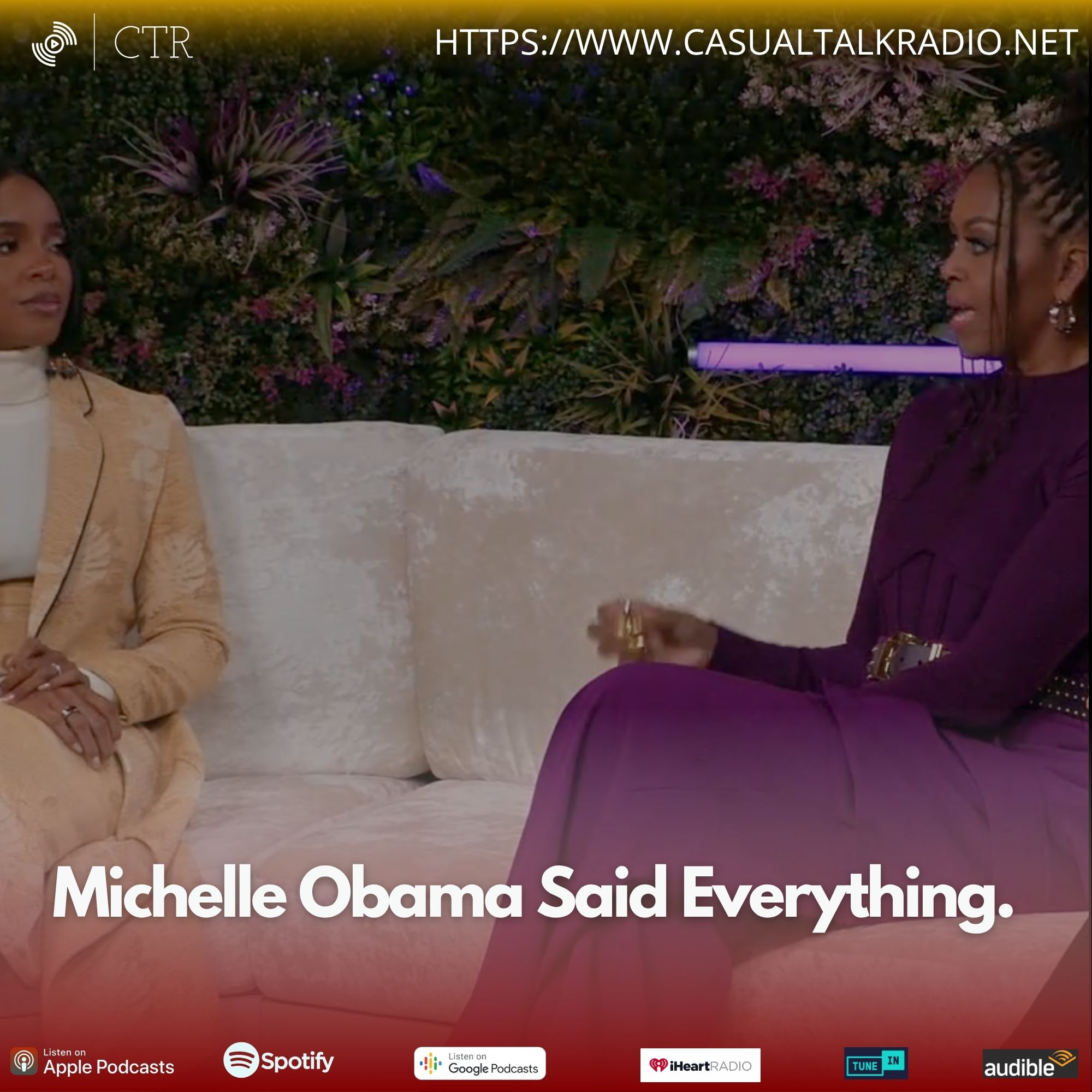
In any event, let's talk about this Michelle Obama business. So Michelle Obama has been doing rounds. She has a podcast of her own and she did a interview and it's, it goes with there's a lot of different people on this panel, by the way. And it's on Revolt. So Revolt X.
Revolt X is the name of it. But it's Revolt tv.
It used to be paid tv. They put it up for free. So you can check it out if you want to. This particular interview is in 2022.
It's got Angie Martinez, she was a rapper slash radio host.
Tina Knowles, which is the mother of Beyonce supermodel Winnie Harlow, she's the one that has like the lighter skin around her mouth, but she's a supermodel.
And Kelly Rowland as well as Another artist, I never heard of her.
So in this, I definitely recommend checking. It is a little bit lengthy. It's almost. It's a little bit over two hours. But I do recommend checking it out. And I, you know, it's interesting because obviously Michelle Obama's older than the rest of them, which I, I didn't, I didn't expect that at all.
But I think it's great to hear some of that messaging be passed down, frankly.
And so I want to.
I want to encourage you to listen to it. But here's some highlights of what she said, and I'm going to share my thoughts on it every step of the way. But one of the main things she talks about, and she. A lot of people took her out of context, but she said something to the effect, I paraphrase, you know, she hated Barack Obama for 10 years, but that's when the kids were little. And it was because when the kids were little, she all of a sudden, like, before they had kids, they're the, you know, happy couple. They're spending time together, they're doing stuff together, and then the kids are born.
And it's like she's now the child rear. She has to be the one to raise the children and take care of the children and do the diapers and the whole nine. And there's a bitterness because apparently Barack's going golfing and doing all these things, you know, that a man does.
And so the traditional gender role starts to play in. And it. She even says it was very straining on their relationship.
And she said that once the kids were out, it's like, okay, we're back again. Now we're doing our thing. And it got me thinking. It's like, well, I understand, because this is what society has imposed upon people. Society has imposed this idea that, yes, you should be having these gender roles because the mother is, generally speaking, better at raising the kids than the father.
However, society also shuns that idea because they want equality.
And the flaw with wanting equality is that somebody has to be a breadwinner. Barack Obama obviously was highly educated, you know, then became went into politics. And so he's kind of. He's doing all this stuff, so he's already putting in hard work, and he has to be the breadwinner. She, as far as what she said, she was not the breadwinner at that time. So I think there's kind of a fallacy.
If there's one breadwinner, whichever that is, then you have to kind of accept that the other one's going to need to be the one raising the kids. If you choose to have kids, if you're both breadwinners, there's a case to be made about sharing that load and responsibility. But part, part of the flaw I expect from, like, I've known fathers that think the world of their kids, they just, they're absolutely head over, you know, Shad Gaspard, if you don't know who that is, he's a wrestler. He died saving his kid. He was out doing the surfing and a rip tide hit him and he died saving his son.
Suddenly, nobody expected that. And this is a big, you know, buff guy. He's a strong guy.
And he was on the verge of really improving his physical appearance and everything. He was really working hard. And then all of a sudden that happened. But, you know, you think about a hero that's a hero when you're willing to do that so that your son can live and you would rather give your life for your son. There's very few fathers that would do that. I talked to a childhood friend of mine, she had married back when they were young and I had known her through my teen years and she then married this guy. And when I talked to her later, this is 2022, 2021, 2021. I had talked to her and yeah, she was still with the guy and I was impressed. And she adopted some kids from a different family.
Very, very impressed. I was. Because again, you don't see fathers step up like that very frequently.
And I don't know that age plays any factor. It seems like there's just something about some fathers where there's a, you know, I want to be a dad or etc. And then there's some dads that they didn't want it and maybe they, it was an accident or something and they don't step up like men.
But when Michelle said that, it was interesting.
Not that it's unexpected, but interesting. The, you know, to straight say I hated him for 10 years, to openly say that, to admit I hated him for 10 years. And then again, she was taken out of context because she said, well, I hated him for 10 years, but we've been married for 30 and I would rather have 10 years of hating versus 30, meaning she'd rather hate somebody for 10 years than hate somebody for 30.
I, I get it.
But she was also given some tidbits and snippets and things, and so was Tina Knowles, and I want to share a lot of those as well. But about the whole children thing, because I got asked on a couple of occasions I got asked, you know, why didn't she want to be a father?
I did want to be a father. I actually did.
But here's the problem with being a father that I don't know that a lot of fathers get before they become fathers.
The moment you become a father, if it's your child, right, and you're not coming in like somebody else's kid, I'm talking your own from birth all the way.
The moment you become a father, there are certain things you. You have to accept. One is the child is now the attention. You must give that child the attention. It is not you. And that's hard for people.
It's just disaster when they try to put themselves above the child for whyever they do. But I see it all the time. You can't. You've got the child is the attention. If the child wants you to wake up and attend to it, you got to do it. The child.
There's an extra expense. There's time. There's time off work when they're sick. There's all sorts of.
There's all sorts of things you have to sacrifice if you're gonna have, you know, have that choice and make that shift. It is a significant shift that I don't know that people are ever ready. They think they are, but they're not ready. And so when I think about it, arguably I was never in a relationship where I was close to having my own kids, right? I was never that far. Because the other part of being a father is if you don't get along with the person you're going to have a kid with, whether you stay with them or not, it's not the point. You got to get along with them, and you have to trust that that person is going to nurture the child just like you do. Well, that assumes that they want to have kids, which most do, but not all that also assumes that they're willing to give up their life. And I literally mean that in order to have kids. And many are not. And that's a flaw, because they're pressured at a young age.
I've known countless girls that I went through high school with that ended up PhDs and crazy amounts of money that they make per year because they chose their career. They might have gone back to have kids later, but the vast majority that I see hit those pinnacles, they chose their career over having kids just because that's what they chose. Well, then you feel like as a female, you feel like, okay, am I waiting too long? Is. Am I too Old. Do I hit postpartum? What. What are all these things I got to think about?
And if you're in that mix as a guy, you have to also be sensitive to those thought processes, which is why you have to communicate. If you don't communicate, it causes problems, right? Cuz if you guys are sexually active, let's say it accidentally happens, that's even worse because you weren't prepared, you didn't talk about it and it might cause animus between the two of you.
So. And then once they're born again, they are the attention. And if you cannot accept that, it's. I think it gets a little bit better. But not really, especially if you have multiple kids.
So I. And to hear them, you know, people that didn't have to worry about money, right?
Think about the parents where money is a problem. Think about the ones where they can't make that kind of money or ones where the guy was not financially set going in, or ones where the female was going to go to college, or all these things that get purposely put on hold, derailed because of a decision or an accident. But the point is you choose to continue being a parent, right? That derails your life. It completely does.
Alexa Bliss, who's a West wrestler, she takes her kid with her. She went back, so she had a kid, she came back, she brings her kid with her. And I guess they have some kind of a daycare or something set up in the back. They have like four or five moms that work there now. That's not the way it was in the old days. In the old days it was unthinkable to have a kid while you were working like that. Just because you, you're expected to kind of take off and take care of the kids. So we understand.
And then you think fear, right? If you have a job and you're afraid that your job's going to lay you off or, or you know, discriminate against you because you get pregnant or that this, that and the other. There's a story. I forget what the movie is. There was a movie and they had some girl that was part of the movie. I think it was something with the rock, if I recall. But it was some movie and apparently one of the girls lead girls gets pregnant and it throws off the filming cycle. These are real concerns that a lot of these women deal with, whether they're celebrities or not in the regular workplace and celebrity, it's. It's a normal thing.
So I guess my message is I understood back then everything had to be Right now, this is, this is where I'll360 it here a little bit later. Everything had to be right. It's not just wanting to be a father. That wasn't all I had to understand.
The other person's got to want to be a mother because they're going to be. I'm going to make sure that happens. Second, I had to be financially ready for that. And that didn't happen until way later. I mean, I didn't get. I didn't get to the point of true financial base, financial comfort until like 10 years ago, you know, 10, I would say, arguably 10 years ago is where it started. And then it fell off.
Not because of COVID because of other things. It fell off and then I recovered it and then I was fine, you know, in roughly about 2016, 2017, ish, I was okay. And then Covid hit and then. Or actually it fell off before that. It fell off. That would have been 2000. Yeah, 19 fell off a little bit. It got back on. Then Covid hit, fell off, and then it got back on recently. So now I'm financially set. But at my age, I already understand, yeah, the desire's still there, but I don't know that the going through the birth process and everything else is gonna work. I just don't accept that because there's a lot of. There's a lot of commitments I don't know that I could make. There's too much stuff going on now. That wasn't the case back when I was younger. When I was younger, I could make it work even if it sucked.
Now I don't think I could do it. I have considered adopting though, simply for if no other reason than, you know, I'm inspired by Cat Williams. He adopted a bunch of kids and he said, actually at a point, you know, the reason my reasoning is simple. You know, if I. If there is a. He said, not paraphrase, but he said, if there is a God, what would he think of a person who did this? Right? And that's a compelling case because even if you don't believe in a deity of any sort, even for your own karma or your own self worth, you think about just doing something for somebody else that's going to live beyond you, somebody that's disenfranchised or somebody that's abandoned, or somebody that doesn't have that opportunity to live right, and you give them that opportunity and you give of yourself and what you have accumulated or created for the limited time you're on the earth, you get to pay it forward. I think that's a huge thing. So I have thought about it and I'm now equipped to be able to do it clearly. But there's stuff I have to sort out in the living arrangements, you know, because you have to make sure that they're going to be comfortable. You have to make sure they're going to have, you know, good nourishment, that they're going to be taken care of, that they got good education. There's all these things that need to be set up and I'm not there yet, but I'm working towards it so I can get to that. And I'm okay with that. I'm okay with thinking about adopting. I haven't committed, but I would consider it because at that point I don't have to necessarily commit. Full I have to commit, but not the full that the, you know, the first couple of years really asks of you. So that's. That's where I am.
But I understood as a simple response back when I was wanting to be a father the natural way, I wasn't ready for it and I knew I wasn't ready for it back then and now I resonate why that was the case. It's because all of the women I met, they weren't ready to be mothers either. They didn't desire to be. I don't think any of them to a te desired really to be mothers except the one that already was.
And I liked her and she had a daughter. I told the story, if you knew, welcome. But I told the story about the girl that she was pregnant and had a daughter. And her daughter was the most adorable thing. And I fell in love with her daughter.
But unfortunately, the mother was the worst person walking the earth. And so what am I supposed to do if I'm not going to get along with the mother? I would have loved. If I had gotten along with the mother, I would absolutely have loved to be a father to that child because she was the sweetest thing going, never judgmental, just the sweetest thing you could ever think of. And that was what convinced me, okay, I think I want this. I kind of like this.
But the mom was a terrible person. And if the mom is a terrible person, it's not going to work because you're not going to do right by the child if you two are at ends, right? If you're not on the same page, it's not going to work out. And I understood that the other thing that Michelle was talking about and she was giving all these kind of tips and hints and things learned and. And Tina Knowles. I'll talk about the Tina Knowles one first. Tina Knowles basically said, it's more than what you say to kids. It's what you show. And I'm paraphrasing, but what she's talking about is that you can tell a kid anything, you know, like, don't do that, or, you know, don't smoke or don't do drugs. Don't have sex. You can tell them, but you have to practice what you preach. If you. If you demonstrate certain behaviors, the kid is going to emulate that behavior. Even if they don't emulate it directly, they're going to think that it's okay. Even if they're hearing that it's not okay because they're seeing their parents do it. So that's. That explains, you know, so many kids at a young age, they get into smoking, they get into drinking, they get into drugs because they've seen their parents do it. So many kids that grow up and they get in these relationships and they turn abusive. Why? Because they saw their parents do it. And so for them, it's like, okay, well, I saw my parents do it. So I guess this is all right, right? Because you're observing. It's observed behavior and it's absorbed. The kid is absorbing. Those are the years where they're absorbing these things. It's why I'm always hypercritical of parents who don't understand how to treat and how to raise a child in a way and how to discipline them in a way that actually enriches them. Not to punish, but. But to enrich them and help them understand why. A lot of parents, A lot of parents seem to think that the kid doesn't need to know why. You just need to do. If you do that and you don't explain the why and help them understand, they're going to rebel against you. And that's just the way that kids act, because kids are.
It's in the DNA. It's in the DNA to learn to absorb. Absorb and observe.
Watch what the parents are doing. And then if the kid. The kid sees that the parents doing something that just feels wrong, that kid's going to chafe against that. You don't want this. But too many parents are too consumed with just trying to tell a kid, then they get frustrated, Then they start pulling out belts and extension cords and anything else they can get their hands on, and they abuse their child. Because that's what it is. It's physical abuse. You abuse the kid what are you doing? You're creating a rift between you and that child. Now, some kids, they're of a different condition, right? They're conditioned to say, I'm going. I understood that happened, and I don't like that it happened. And it is what it is. But they're my parents. Some kids aren't that. Some kids are. This is not going to happen. Coco Gal, I believe it's called, or Simone Biles, I get Simone Biles said, no, I'm absolutely not. Me and her do not have any kind of relationship, and we're not going to have a relationship. Because if you've done those things, you have to understand it's going to come back at you. This is all karma.
Karma is a real thing. The things that you do are going to come back on you. And if you don't want that, you have to be mindful of the things that you do. Especially when you're in those formative ages where you're making an impact, that's a negative impact, that's going to scar that person for life.
That's a flaw of so many parents that I see and hear about, because they don't know any other way. Right.
Ike Turner even talked about once. It's like, look, this is the way I was raised. I don't know any other way. You know, Joe Jackson, I. I don't know any other way. That's. That's. That was the way. And then it just festers. Young kids adopt it, and then they start being abusive.
Then going back to Michelle Obama, she was talking about how with, like, you know, Malia, she's trying to make her own way and be her own person and learn, and she has to learn how to live in society. You are a notable person because, not because of anything you did, but because your parents. And you have to learn how to live with people. You have to learn how to make friends. You have to learn how to do these things.
And we have to get you to the point that you're comfortable being in public and that you're comfortable going out and having a good time, but you're also safe and you're also doing that. And it's a struggle. It's a balance, because you want them to go and be something in life, but you're coming from this walk and you have to kind of go. And then there's parents that. And this isn't Obama, but there are parents who. They just have it in their mind that the kid is just going to follow in their footsteps.
Sometimes they will but sometimes they shouldn't. This goes to. Like with the Presleys. You know, the kids didn't want to go into music. And you know, David Ruffin's kids, his son did, but the rest of them didn't. They weren't interested in going to music. You know, Eddie Kendricks, his daughter, she went into music for a beef. You know, some will, but not everyone does. So there should not be an assumption that they should. And part of the flaw of kids and the way that parents and schools teach them is that nobody seems to get. The kids should be allowed to experience a lot and then choose what seems to resonate with you and then nurture it and cultivate it.
Don't fixate on one thing and try to force it. Expose them to a lot of different things and then let them choose. Because, like with school, great example, our school system's all messed up. We throw a potpourri of classes, okay? And we expect.
And I think it's changed since, but we expect the kid to just divine that this is what. What classes are going to be the best for me based on a certain job. And we pair them with guidance counselors who ask these generic questions, and none of it's of any impact. Now we push stem when some kids are simply not attuned to stem. Some kids, that's just not going to work for them. Some kids, they should be able to do something a lot different than that, and it's just not the right answer. So I don't know, frankly, what that's all about.
I don't. I think we have, as society, when I say we, we have gotten to this point where we don't really know how to cultivate. We don't know how to enrich, we don't know how to enlighten. We don't know how to push people to their next greatest level.
And as a struggle that we go through over time, we create this animus that just. It just festers generation after generation. It never goes away, which causes them to then push back on the things from the older generations. Because the kids grew up now and they resent what they had to go through. So I hear, why do I have to count change? And why do I have to sign? You know, why do I have to do these things?
Because nobody ever taught kids the value of holding cash in your hand. Nobody ever taught the kids the value of having a unique signature and practice privacy. And why these things matter. Balancing a checkbook, managing your credit. Nobody teaches the kids these things. It used to be that we did, but then we stopped.
These are things that we have done that have damaged the relationships with the kids, and it's caused it to be much, much more difficult than it used to be. And then the last thing I'll talk about with Michelle Obama now, she was talking about, you know, in terms of the overall just relationship in general.
And she was talking about how, you know, ultimately there, there, there are these points of time where, you know, girls will get into a relationship, they'll get married, and they're rushing and why are you rushing to get married?
And she was saying, you really have to take the time to know you. You have to learn who you are first. You have to. And that person needs to be whole that you're going to think of marrying. They have to be complete. And complete is not defined by you, it's defined by them. Right? They have to know who they are. You have to know who you are. You have to learn yourself. And you're not going to know yourself in your 20s, right? You're not going to know yourself in your 30s. It's a constant journey over years. But there's this rush to getting married that doesn't make sense because by the time you do, that's why there's so much high divorce rate, right? Is there's so much rushing to get married. And somebody's like, well, why? Why is that? And I wanted to share my thoughts on that.
Part of the problem is people don't understand the origins of marriages compared to the current state of them. The origins of marriage were around property. That's the bottom line. It goes back countless, countless centuries. Marriage originated largely around property. When I say property, I don't just mean physical property that you own. I mean where the man was essentially a claiming the woman as property with the intent being child rearing. And if the woman was not able to bear children, the man could basically say, okay, drop them, and I'm gonna go get another one. That's the origins of it. It's property. But it was also tangible property.
Common law, wife married. You know, you say, this is my common law. Why Was around, okay, we're coming together and we agree this is what we're going to do, but it's not recognized by any, you know, some states, some limited states still do, but by and large there's not things you're entitled to.
But because it has its origins in property, at some point society said, well, you really should only be marrying somebody you love. Right? The truth is that's. That sounds good. It sounds good. But it's always been and always will be about property. Here's the bottom line.
Married couples have more tax breaks.
Child, you know, parent, you know, couples with children have more tax breaks.
Couples are entitled to property, shared property. Even if you do a prenup, sometimes the prenup doesn't really do much. You're still having these property based conversations. That's just the way of it.
Property is the bottom line of the greatest reason why somebody would get married. Now, that's not a dangerous down point. It's just yet to recognize it. Because once you recognize it, you say, one person's got the property and one person does not. Or the woman says, yes, I am marrying this person so I can give them children.
Or I'm saying I want to be married because I don't want to be, you know, left alone. Or I don't want that person to claim somebody else. Or you're doing it for selfish reasons. I mean, that's fine. But the truth is, it's all about property. It's always been, it always will be.
That means there's a money motivation. Because even our government basically financially incentivizes you for being married. They want you to be married.
They don't financially incentivize you for divorces. And that is a burden on the taxpayers because we have to pay for all that stuff that doesn't come out of everybody's pocket. But it's still a burden on the system that creates tax burden on you at some level down deep.
So the point is there's a financial incentive to getting married. That's why they rush into it. Plus there's pressure from family, friends. I see this married couple and I would challenge, it's fine to bow to the pressure. I never was going to.
I felt if there's gonna, if you're gonna get married, it should be because you both understand we're doing it for property reasons. We're doing it because shared property is important and we want to raise a family together and, and benefit from that. Not just for ambiguous love that may or may not last. And that sounds kind of crass, but I'm. That's how I felt about it. And I was inspired to hear Michelle say, don't rush into it. And that's what I would say to everybody listening. Don't rush. Just take your time.
Oh.