[00:00:00] Foreign.
[00:00:05] You're listening to casual talk radio where common sense is still the norm whether you're a new or long time listener. We appreciate you joining us today. Visit
[email protected] and now here's your host. Ler. I thought it might be a good time for a controversial piece. It might be a good time to talk about a controversial topic. It's probably appropriate, timely. So I'm going to go ahead with that. And just for disclosure where you may or may not care, but I share it. Just so you know, the microphone's location has moved because its mount has moved because the chair has moved. So I may sound different than usual. Hopefully it does not sound worse. At minimum, I want to sound better and I'll be doing everything I can to optimize the audio the entire way. I just wanted to be clear if you are hearing a difference, it's because of logistical things that are changing that they'll be changing over the next couple of weeks and we'll settle it.
[00:01:06] But I thought it's about that time for a controversial topic because I did one already on snap and obviously they're trying to vote to reopen. The government now needs to go to the House for their final sign off, then to Donald Trump. And I don't know if the House is going to shoot it down.
[00:01:22] But it was relevant to today's topic because there was a set of, I would argue, centrist Democrats that crossed the line, as it were, to sign the Senate legislation, give enough votes to pass the Senate so that Trump administration did not have to end the filibuster, which was something that Trump was pushing to do. And they didn't want to do it because, you know, they do the no kings. There was a lady, I forget her name, but she was joking about the no kings because part of the whole SNAP deal is about funding. That's the whole thing around SNAP is funding money availability.
[00:02:00] The executive branch can't just print money out of thin air. It has to go to Congress. And if Congress doesn't approve doing it, nothing gets funded. That's not the fault is what they were saying. That's not the fault of the executive branch. That's the fault of Congress, which is includes Senate. House has already said that they would be okay with this, but the Senate has to approve. And the Senate not approving is largely Democrats causing it, which means they're the ones that are blocking the funding, that's blocking the aid. And this lady, she was saying it's funny, they're out there Marching about this. No kings. But yet they want Donald Trump to try to act like a king and just make money appear because he is in charge. Well, it doesn't work that way. And now they're learning that, that it's not about kings. He's not acting like a king. He's still working within the framework of the system that allows him to do certain things.
[00:02:47] So I thought that was good. Meanwhile, this got me recollecting my other set of updates that I wanted to talk about that I thought now was probably the best time to do it.
[00:02:59] There are some people possibly listening to the show who would consider themselves feminists.
[00:03:08] Part of the problem I think with feminism is a lack of understanding of the history of it. People that didn't do research on it, that's number one.
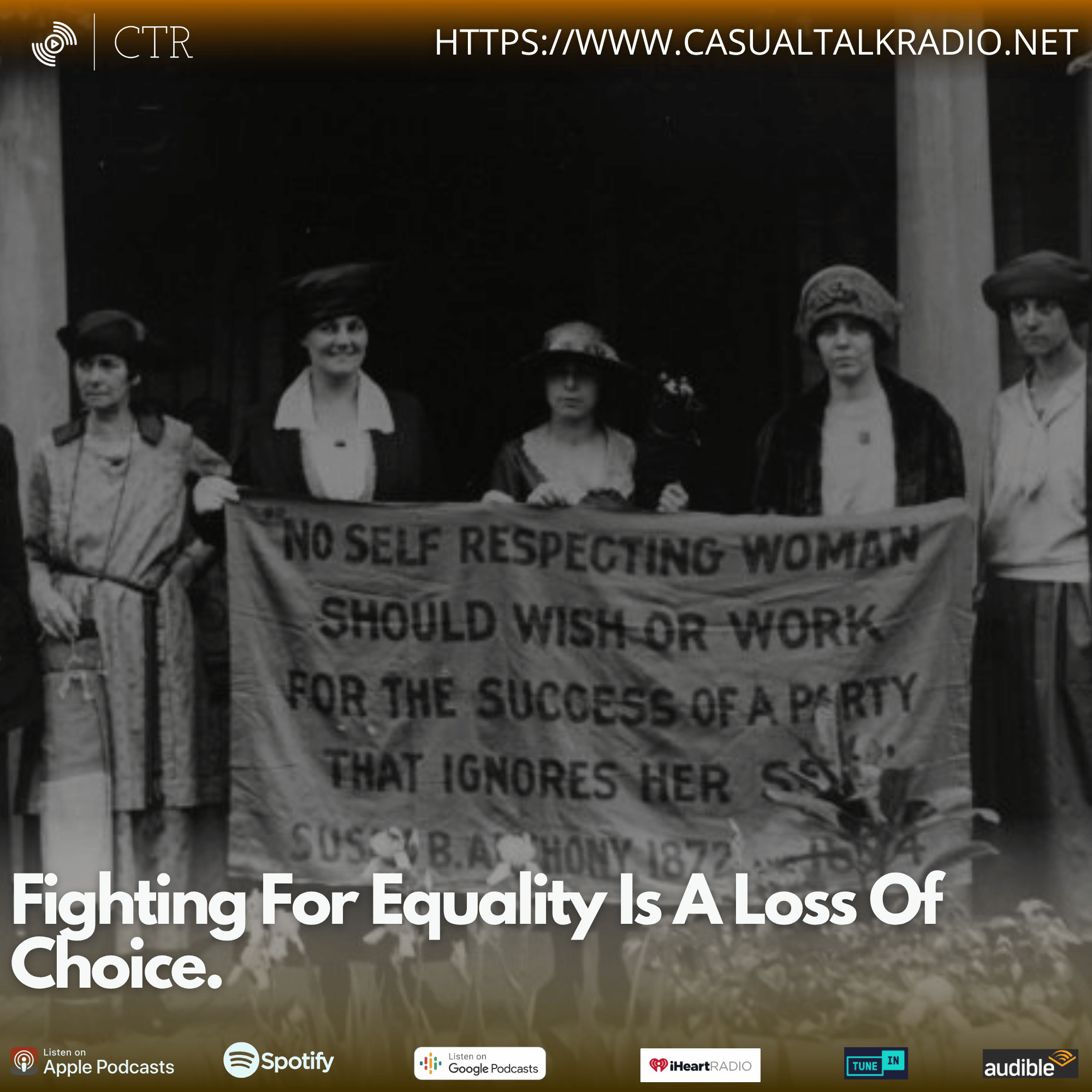
[00:03:19] But number two, the fight for equality, equal rights has been going on for endless decades.
[00:03:27] And I don't know there's a full understanding or appreciation of for that battle because a lot of the history behind surfaced a lot of hurt feelings, a lot of concerns, a lot of issues that I don't think the modern because they don't really do a lot of history studying. They don't know or appreciate what's really going on. They don't know that the Equal Rights Amendment, for example, isn't fully ratified across the board, that there are some states that did not ratify it, that there are some states that initially did and then pulled it back, that we still don't have a true unified thought process around the Equal Rights Amendment.
[00:04:12] I thought it was good to try to help clarify why that might be the case. And this may spin over, I think, into hopefully at least using somewhat of my platform to try to help people understand the other side.
[00:04:32] I may fail, it may not work, but I'm going to try best I can.
[00:04:40] So part of the push was women that wanted equal protections, equal treatments.
[00:04:53] They wanted to be thought of equally, not just in equal gender based inequality.
[00:05:02] They didn't want to have, they didn't want to have a loss of opportunity, but they certainly did not feel that what they did have was equivalent to, to men.
[00:05:17] This went for multiple different things.
[00:05:21] The other side never really understood. And when I say other side, I'll clarify in a second. But they never really understood what's the reason for this push.
[00:05:32] You have a segment of women who had felt at the time that they there's nothing wrong with being a homemaker, there's nothing wrong with being a mother, there's nothing wrong with these.
[00:05:47] And by doing what you're doing.
[00:05:49] We risk losing the right to do that if that's what we choose. That the loss of choice was the big concern and reason. It was a contentious issue all along.
[00:06:02] The other side, which is on the male side, has long said, well, let's understand what equal rights really means.
[00:06:12] If we're saying that you should be able to work the same jobs as men, that means your fair game. Your daughters, when they turn 18, between 18 and 23, I believe it was, or 18, 25, are fair game for the draft.
[00:06:28] Some women, modern women, don't know about the draft. They don't know what it is. They don't know what it means or what it meant.
[00:06:36] The draft, when you turn 18. I talked about this in old episode.
[00:06:41] When you turn 18 as a young man and it. I don't think it's physical anymore. It might still be, but time. You were sent a little postcard in the mail that said you have to register for what's called selective service.
[00:06:54] Selective service, in simple terms, says if the government needs to draft you, we can, and there's nothing you can do about it. You are required by law, last I checked, to do that.
[00:07:07] And women were always exempt from selective service because they're women.
[00:07:16] There are women out there who feel like they should be able to serve in the military, and many do. I know some that have served in air force, military police, Navy, army. I've known women that have good friends of mine.
[00:07:33] But the draft is a different conversation.
[00:07:36] Because in the draft, you're purposely saying the only reason that they would do a draft, by the way, is they're going to war, it's wartime, and there's a deficit of enough young soldiers. So essentially it's almost guaranteed some of them are going to die.
[00:07:51] That's the only time that there would be a real on draft.
[00:07:55] So there hasn't been significant draft activity for a long time.
[00:08:01] So the risk is low, but the risk is still there. And that was the open door people said is equal means you're fair game for the draft.
[00:08:09] Some didn't think that part through.
[00:08:13] But then it got a little bit more contentious.
[00:08:16] People went deeper into what is it really? That's the problem. Right? Let's talk about what's the problem that we're trying to solve by being against equal rights and being against being equal under the law, that we want the government, federal and state, to say this is a protection that does not, that offers us the open door to be on the same level and does not limit what we already can do.
[00:08:53] But the interpretation at the time, which I think is a fallacy of now, which is why I bring it up, many people understood that yes, there were going to be losses of your inherent rights because it also opens the door when you say equal.
[00:09:11] It allows men to do stuff that you can do.
[00:09:14] So then more people. Now you fast forward, right, you get into this conversation about gender specific bathrooms and women like, wait a minute, men shouldn't walk into the bathroom, women's bathroom, what are you talking about?
[00:09:27] The other side is saying, well, wait a minute, you just said we should be equal, it should be equal playing field. So there should not be any sort of gender separation for bathrooms.
[00:09:40] Women on that side say, well, yeah, but no, I meant this over here, this specific thing. The other side is been saying, you can't have it, you can't cherry pick it that way.
[00:09:52] If you're saying equal, you're saying that the men can also encroach on your stuff as well.
[00:10:01] The men can also make you do stuff that you know that previously they would not make you do.
[00:10:09] So you got to think this through a little bit more of what you're asking for. And what they're saying is it's more.
[00:10:16] It's more than just you being able to work a job the way the government works. When you try to put it at the government level, they're not going to interpret it as your little cherry picked rights that you're looking for.
[00:10:30] That's opening the door for men to encroach on your rights across the board.
[00:10:36] It's going to open a lot of doors that you didn't think were going to open because you didn't understand how bad it is that this was going to be for you then. It was even within the work. And we have this now.
[00:10:55] A lot of women are subject to overwork at the job.
[00:11:00] Women who choose to have children, they're under stress, they're often overworked, they're balancing all these conflicting priorities and a lot of single mothers are struggling to keep up with what they're doing.
[00:11:19] The bottom line is that a lot of that is a byproduct of a lot of the push for equality.
[00:11:27] The system overall understood that this isn't going to fly forever.
[00:11:35] We're not going to be able to isolate the women forever. At some point they're going to fight.
[00:11:40] So when they fight, we'll open that door and then we'll open more doors and nothing really gets better. It actually gets progressively worse. You now have this gender bathroom situation.
[00:11:53] It's a problem.
[00:11:55] Abortion is further a problem and not because of the Roe v. Wade updated decision. That's not why it became a further problem.
[00:12:05] It became a further problem because the states ultimately always had the right to say what can happen within the state borders.
[00:12:16] Always have.
[00:12:18] They always will.
[00:12:20] So the what happens there?
[00:12:23] You have, regardless of gender, the right to uproot and go to that state that lets you do what you want.
[00:12:31] People, regardless of gender, don't want to leave. They don't feel like they should have to move.
[00:12:38] That's broken because that's what we would have done decades ago, in the 60s and 70s, et cetera. We go where the opportunity is. We go, go head west, young man. We move.
[00:12:49] And it was normal.
[00:12:52] I'm connecting more dots.
[00:12:55] Recently Donald Trump floated the idea of a 50 year mortgage.
[00:13:00] People are mixed on this.
[00:13:03] So am I. I understand the thought. I'm mixed on it.
[00:13:07] Mortgages, if you think of what a mortgage is, a mortgage is borrowing money from a bank in exchange for a deed that says we'll let you live here as long as you pay the bill. That's basically what it does.
[00:13:19] If it's in an HOA area, they can take your house. The IRS can take your house. If you are a deadbeat for a certain level property taxes, they could take your house. There's all sorts of things that can take this from you. But meanwhile you're paying mortgage, you're paying taxes, you're paying insurance things, things to up, fix stuff, upgrade stuff, replace stuff.
[00:13:42] It's a money sink.
[00:13:44] It is a consistent money sink. It for some people, the price of houses has not gone down, it's gone up significantly. The cost of living has not kept a pace with the cost of that.
[00:13:59] Houses by their very nature, assume a nuclear family, multiple rooms, etc.
[00:14:07] The system assumes that if you're a single person, you're just going to get a condo or a townhome or a cottage in certain areas.
[00:14:15] But they charge roughly the same price as if you were to get a house. Unless you were to go like with a trailer or something. And the trailer has its own issues. There's privacy issues, there's security issues, there's safety issues. There's all sorts of problems with those kind of multi family situations or you know, properties that are shared property. And then you still have HOA chaos.
[00:14:37] If you are, I'm taking you back in time. If you're a young 18 to 25 female, the push for equality has made it 10 times harder for you just to get started. If you go straight to college assuming you have your parents supporting you, it's a little bit easier.
[00:15:01] Because the bias on the job market for certain jobs is to hire attractive females. That's just the truth.
[00:15:11] But for other jobs the bias is to hire a man.
[00:15:15] That's just the truth.
[00:15:17] Certain women have accepted. There are certain jobs I'm a shoe in to get because of the way I look or because of something I have to offer or my age or something else or many of them turn to like only fans or something.
[00:15:33] They're doing what they feel they must do in order to survive. And that might be as a jump off to larger, bigger, better things.
[00:15:44] Every female that has taken on the mantle that I am going to do what I got to do to get ahead.
[00:15:54] I as a call to action, I want you to think about why you felt you had to do that. And if your default answer is men, you're partially correct.
[00:16:08] The real answer, it's a combination answer.
[00:16:13] It's men to some degree certain of and it's feminists.
[00:16:19] It's both.
[00:16:20] The feminists that were harping for equality didn't understand what they were asking and how certain men in power would turn that into an opportunity to lessen your opportunities. It's an ironic shift, but that's literally what happened.
[00:16:41] Because if I'm wrong, how can it be that statistically women are paid less than men for the same job?
[00:16:48] Because at one point they weren't working those jobs. They could not the equal rights never said it never said that you would get the same money as a man for the same job.
[00:17:03] It said equal opportunities right. You have the right to work the job, you have the right to earn. The system created the compa ratio method which is a range.
[00:17:15] They have the right to put whoever at whatever part of the range the commit is. We offer you a salary and it's somewhere within the range. We base that on 50 million factors or whatnot. So us yours is going to be different because of ABC versus this guy.
[00:17:34] Because you're both in that range.
[00:17:37] It is quote unquote equal because you were never guaranteed to get the same dollar amount. That didn't make any sense. The range is how they cheated you.
[00:17:48] College exacerbates that situation because college gives people a false sense of accomplishment that lends itself to a belief that you're automatically going to be hitting those levels of the lady because you're told that the college is fundamentally all you need to get started in your career.
[00:18:11] You're told about networking.
[00:18:14] My my whole stuff didn't come from networking.
[00:18:18] My stuff came because I happened. This is roll of the dice.
[00:18:23] I happened to be working at a company that did not appreciate what I was doing, despite me being the number one performer. And that was run by a man at three levels.
[00:18:35] I moved to a different department, same company run by a woman, the director that I've told story about.
[00:18:43] When that other. That man cheated me out of my bonus, she went to bat and got me my bonus.
[00:18:49] She made sure that I could take the classes I need to learn the trade so I could do what she was asking me to do.
[00:18:55] She supported me as I was growing and developing and learning stuff I had never needed to know.
[00:19:03] If not for her taking me under my wing, taking under her wing and saying, you got to step up. I wouldn't be. At this point, she was one of six people that started that company.
[00:19:20] She was an overworked, extremely stressed person by the time she eventually walked away.
[00:19:32] But I understood how hard it had to be for her, for many others, just to get to that point of being treated with the same level of consideration. And she certainly had the respect of her peers, at least all but one of them.
[00:19:50] She had that respect because she commanded it.
[00:19:54] She had to. She could not be passive. She could not be the sit back.
[00:19:59] But you think about what she had to sacrifice. She never had children.
[00:20:04] She never got to really enjoy life.
[00:20:07] All she had was the work. And then when the work's gone, yes, she can kind of settle down and work with her brother. Her. I think her mother had just passed or something. Now she can kind of slow down the wheels and relax a bit. But at what cost? Look how much life has passed you by.
[00:20:26] This is not to dismiss her level of success. It's to say some women are. That they're just machines and that's what they do. I told the story about the girl in high school, rltc, straight A student, went to.
[00:20:45] I think she became. I think she went to military and then she went and got a super degree and made half a million dollars or something.
[00:20:52] We knew that that's what she wanted to do. She was just boom, boom, boom, boom, boom, another one. She has like six different college degrees, which is unthinkable, but she has like six different college degrees.
[00:21:03] Finally got married in her 40s later.
[00:21:06] But my point is that these women, they are inspirations, but they're also outliers.
[00:21:17] They're outliers because the system doesn't support you doing that unless you bust your ass to get there. And it takes decades Often before you hit a peak, by which time you've not had a chance to really learn yourself. And then remember, our bodies essentially shut down. Our normal things, the things that excite us, the things that, you know, reproduce, the things that energize us, start to dwindle as we get older.
[00:21:47] So you lose that time. Now, that might be to your positive, because sometimes in your youth you were kind of foolish, right?
[00:21:55] I'm suggesting only as that call to action I talked about.
[00:22:00] Consider why, if you're that in mind, if. And you're just. I just want to do. I just want to be. I just want to have consider why. Is that because of something that inspired you? Or is it because somebody told you it's what you should do?
[00:22:16] And then think about the alternative, really think about it. I am. I don't want somebody to get married fresh out of high school. That's not what I'm advocating.
[00:22:24] I'm saying there's a time of your life where you have to understand yourself and that takes time to get completely settled.
[00:22:37] At the same time you're doing that, though.
[00:22:40] I just say think about what's so bad.
[00:22:45] And let's break it down in segments as I close.
[00:22:48] Think about what's so bad about being protected.
[00:22:53] Think about what's so bad about being provided for. And I'll talk about that in a second.
[00:22:59] Think about what's so bad about being a home baker. Homemaker. Think about what's so bad about being a mother.
[00:23:07] Now let's talk about the provide. Because sometimes people misinterpret what we mean by provider, being a provider and being provided for society. You've heard in media they are denouncing the idea of childbirth in general. That's why the government said birthing people, because they're denouncing this idea that childbirth is a positive.
[00:23:34] They're telling you that going to work and slaving at work is what you really should want to do. You shouldn't want to be pregnant. You shouldn't want to have kids that you take care of and that you're home with them and you're helping them grow together and you're learning and having fun with them. They denounce that. Society denounces that idea. So why is it so wrong if you have kids, though?
[00:23:59] Remember that the government gives you incentives because you had kids, because they understand you need more help.
[00:24:07] Some of them, I'm going to just use them as a term generically speaking. Some of them treat that as dependency.
[00:24:15] You shouldn't want to be Dependent like that.
[00:24:19] So if you don't have kids, you're not going to be dependent. You can do your own thing, go to college, get a good job, you make the money. You don't need to be dependent.
[00:24:26] There's nothing wrong with self sufficiency.
[00:24:30] But if you miss out on an opportunity to be a mother when you could have, and you wanted to simply because some influencer or friends, family, whatever, discouraged you from doing it, I'm simply asking, think it through without them in the room. Sit and look at a white wall and just think it through.
[00:24:54] Consider what you would be missing. And it might be that it's not for you.
[00:25:00] As long as it's your decision and not influenced by other people, is all I'm saying.
[00:25:06] Being a homemaker. I have a book, I forget her name. I'll do an update episode at some point about her stuff because I thought it was really good. She passed away, but she was talking about why is it that women don't want to be homemakers and take care of the home?
[00:25:20] Most of them, when they were kids, they had the little dollhouse and they took imminent care of it at all time.
[00:25:27] So what's different? Why would you not want to do that in a home that you live in, that you paid for, that's part of your value and property. You don't want to take care of that, but you were taking care of the dollhouse. What's different?
[00:25:37] Compelling stuff. Why wouldn't you want to be a homemaker?
[00:25:40] I'm not suggesting that you buy.
[00:25:43] I'm saying that taking care of the place that you live and making sure that it's a clean place for your significant other to come back to, for your kids to be raised in, making sure it's safe, making sure to do the things that upgrade it and, and keep it up.
[00:26:00] Yes, that costs money which gets to the provider.
[00:26:04] People get offended when you say, why don't you want to have somebody provide for you? But that's being dependent. No, dependency assumes you can't do it.
[00:26:16] Having somebody provide for you can be a choice that you accept. You willingly accept it. And it doesn't mean that you don't do your own stuff. You can do hobbies at home, you can work with the local church, you can work at local volunteer, you can do all sorts of stuff that fulfills you.
[00:26:33] But listen to what I just said. I'm talking about stuff that fulfills you. It enriches you. It makes you think that you're contributing back, not just a slave to the rhythm to quote Michael Jackson, that you're just going to work and clocking in and clocking out every day, you might love your job.
[00:26:52] I go back again.
[00:26:55] Women in the workplace, by and large are not treated with the same considerations for things like time off, for things like stress management, constant meetings, constant haranguing, having to be on teams if you're remote commute.
[00:27:11] There's all sorts of deficiencies in the way that we treat women in the workplace.
[00:27:18] And I'm suggesting to find something that you want to do where you have control of that channel. But if it's something that's unpaid because you're doing it because you want to do it regardless of money, there's nothing wrong with somebody who is providing for you because it's by your choice, you are allowing it to happen. There may be a certain quid pro quo to it.
[00:27:42] The quid pro might be we're in this relationship together, I will provide for you in exchange. Yes, I want to start a family right. There are some gives and takes that you might not be willing to compromise, nor do I expect that you do. I'm saying to think about.
[00:28:00] If somebody's telling you that providing for you is a dependency, I would say no. I would say having somebody provide for you because you choose it and you are empowered to do whatever you want to do.
[00:28:12] I consider that the best thing as opposed to feeling like you have to work and slave a 9 to 5 to make stuff work. If you've got somebody that's a breadwinner and they're able to make that good money, let them.
[00:28:28] You just have to understand what your role then would be. Your role is this is the provider I got to take. Make sure that that person's got a good happy home to come home to. And that may be a compromise you're not willing to make.
[00:28:42] If you're not willing to make it, don't.
[00:28:45] In summary, I'm simply saying that anything you decide to do should not be told to you by somebody else telling you to do it that way.
[00:28:57] Somebody shouldn't tell you marriage is bad for you, don't get married. Somebody shouldn't tell you don't have kids.
[00:29:02] They can share their opinion about their experience of what they felt at the end of it. You should be the one deciding for yourself what makes sense for you.
[00:29:13] And I am encouraging to focus on that which enriches you, that which makes you smile, that which does not lend itself to stress, while at the same time keeping in mind health.
[00:29:28] Some of that's in our control and some of it's not.
[00:29:31] So if you do go and you're going to be the breadwinner, you do it yourself, you're going to make this kind of money.
[00:29:37] Consider what happens if something happens to you.
[00:29:40] Does it put you in a rut where now you don't have something to fall back on?
[00:29:45] If you're relying on somebody as a provider and you're just doing volunteer and they lose their job or they get disabled or hurt, what happens to your situation?
[00:29:56] These are all things you should think about.
[00:29:59] It all has to make sense to you.
[00:30:02] Not to some external, not to some friend family, not to a social media influencer, not to a cart Asian. It's got to make sense to you and be brave enough to think it through. That rhymes. And consider that feminism has had the right idea, but it doesn't conceptually understand how the system distorts what's being requested into something that actually is to your detriment. And that is why it feels harder for you, because it is. Because things have been purposely made harder, because the system always wants to stay ahead of where you're trying to do. And you'll never overcome that.
[00:30:48] You work within the system and that means, unfortunately, relying on people, as long as you can learn why, to rely on them. And it's your decision that's power. And it's power nobody can take from you.
[00:31:18] Oh, who you oh.