[00:00:00] Foreign.
[00:00:05] You're listening to casual talk radio where common sense is still the norm whether you're a new or long time listener. We appreciate you joining us today. Visit
[email protected] and now here's your host, Leister.
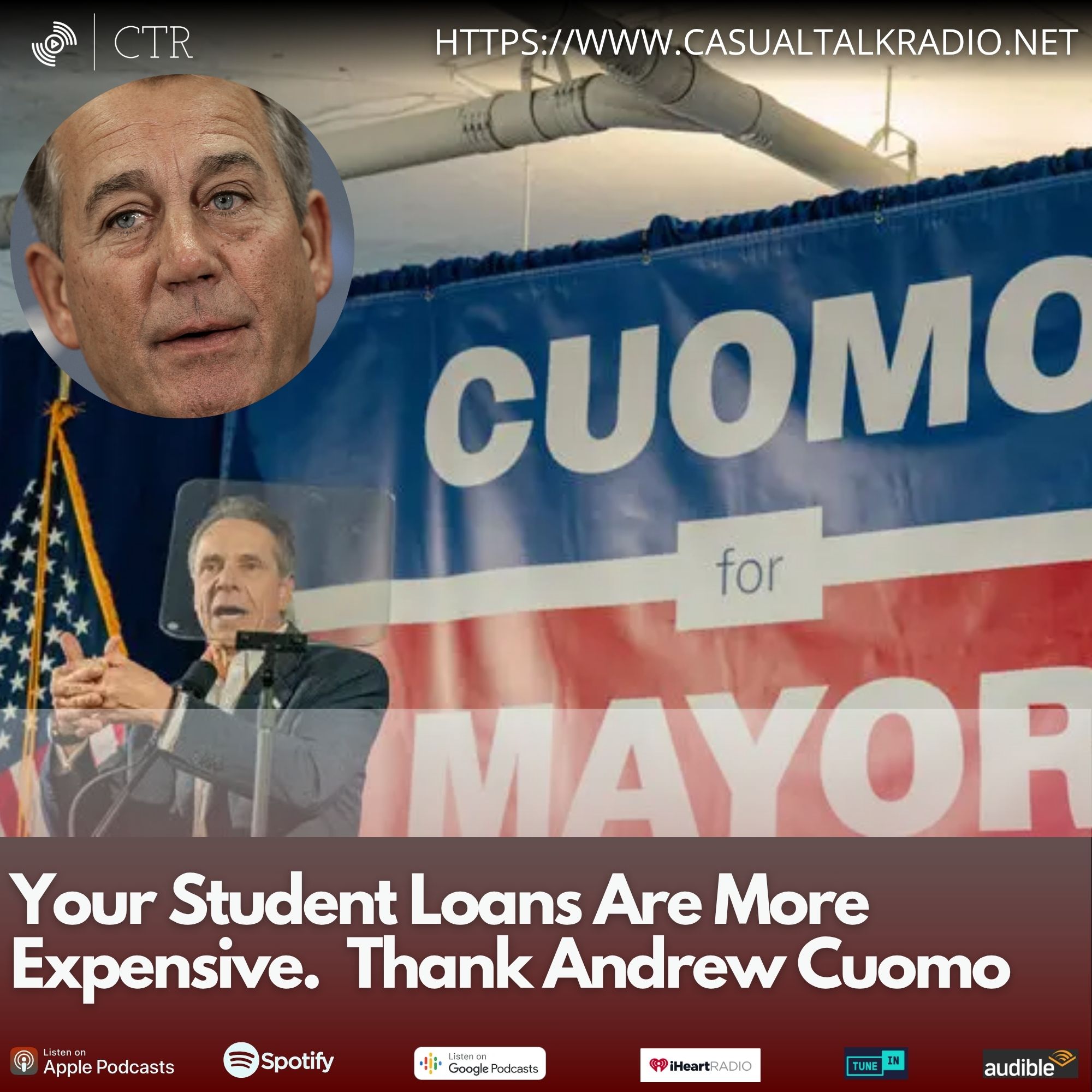
[00:00:21] You know that Andrew Cuomo won't go away is an indictment on New York.
[00:00:28] It's an indictment on the people of New York to even consider him. Continue considering him for these positions. And there'll be people I know that will say, Donald Trump, here's the separation that we need to understand.
[00:00:46] Donald Trump, let's talk about some of the stuff. We're not going to beleaguer it because it's pointless. Okay?
[00:00:53] Off color comments made in private that were recorded in secret, albeit illegally, that he made about something that is factually accurate, which is that certain women allow powerful wealthy men to grope them. We know that happens. It shouldn't, but it does. It happens all the freaking time.
[00:01:12] This is why Diddy was allowed to do what he was allowed to do because of his wealth. Many of them acknowledged that they were, it was consensual that they consented to doing it. They wouldn't just consent to somebody who was broke and ugly. They consented because of his wealth and his status. That just simply affirmed what Trump said in private, illegally recorded is true. There are women that do that. We know that's the case.
[00:01:42] Doesn't excuse the comment. No, but it was said in private.
[00:01:46] That's not the same as Andrew Cuomo sexually harassing multiple women while in office.
[00:01:52] That's not the same as Anthony Cuomo and all the scandals that he's been called up on the lamb on multiple times.
[00:01:59] I gotta tell you, this guy, I don't know why he won't just go away. Like, why doesn't he just go to some island, take his multi millions, which I'm gonna talk about in a second turn, take his multi millions, go off to some island by Epstein's island, you know, go somewhere and go away.
[00:02:15] He won't go away. And so people still even giving him a voice, that's an indictment on society and especially New York society. They're just, that's Stockholm syndrome. These are people that don't understand when they're being abused. And they will not. They're, they're not, they're beyond help, okay? They're not going to recover.
[00:02:36] They're beyond help.
[00:02:38] But I thought I saw somebody made a comment about their feelings on Cuomo and everything. It got me remembering a long past, something that many may not be aware of or realize. So when Donald Trump got back in office, one of the first things that he did was unravel what Biden was trying to do, which is called the SAVE act, which was trying to alleviate people that had student loan debt.
[00:03:09] And Biden had pushed and pushed to try to cram through regulation that would basically wash debt away. It just basically make it disappear.
[00:03:19] Now, this doesn't mean that it wasn't going to be paid for. It comes out of tax dollars. So if you pay taxes, you're basically paying for it. And that pissed a lot of people off, rightfully so.
[00:03:30] In all disclaimer I do have some federal student loans.
[00:03:34] I was actually eligible for the waiver.
[00:03:38] I just basically said I got a choice.
[00:03:42] Do I pay it right and just pay them off or die? And then they're, you know, whatever happens to it.
[00:03:50] And I got to think that through and I haven't decided yet. I'm saying that right. That's where I'm at. Because it took so long with everything that was going on, with all the difficulties that I talked about in the past episode and if you're new, welcome. But in the past episode I talked about how there were difficulties getting into college at the time that it would have been mentally appropriate for me.
[00:04:12] So I went back later.
[00:04:14] But at that time it's like I've been working full stop.
[00:04:18] I've got way more knowledge than what they're talking about and we're taking stupid classes that are not relevant to my job and you want how much money. And so wgu, which is a scam. And I'll say it's a scam because it's a scam.
[00:04:32] And I might do a different episode on WGU because I don't think I have.
[00:04:36] Maybe I will. Maybe that'll be next week's we'll see. But WG is the scam, bottom line.
[00:04:43] Let's see, Ashworth College, I think was a decent for certain people, not everybody UMass. No. You know, I've gone through a lot of different colleges in my journey. I actually had a Reddit forum. I started around this and the forum still out there.
[00:05:06] I collected up a bunch of information about online colleges and learning and it seemed to help a lot of people.
[00:05:12] But getting back to the point when early on it would have been mentally appropriate for me to go. There were family problems that negated me going when I was ready and then later when those family problems went away. Now I'm already way more experienced such that these classes see college the big flaw of college is their persistence on including classes that are not relevant to getting you ready for the workplace or improving your ability to work. They want you to be well rounded and it doesn't work a because they do not talk about every culture like they should be because they force garbage classes. It's the bottom line. If your career of choice involves something like myself, which is business process improvement, there's no value in me taking trigonometry as an example.
[00:06:08] So I did go back, I did complete a program, so I did get a degree. I don't know what value it was, frankly, but it's whatever. It shows up on a resume. Not that I have to really use it because I'm a business owner now. But suffice to say, I did complete the process.
[00:06:24] I have significant, I would argue student loan debt.
[00:06:31] Did I get enough out of the curriculum to justify the money? I say no, not, not even close because again, I was already working at a high clip, making a lot of money. I was making like we're talking, geez, what was I, 20, 20 years old and I was already making 60 grand a year. Now mind you, at that time, people were barely making like barely making 20, $30,000 a year.
[00:07:05] I was way higher than that because in that career, which was customer service, it was red hot. This is before the Internet got big. This is before AI, this is before chat. This is before all these tools we take for granted now.
[00:07:22] This is you call a number, you wait in a queue, yes, but there was no automated person answering. It was somebody like myself who would answer your call and help you with your Internet, help with your phone, help with your cable. Right?
[00:07:36] And that was, that was huge, huge for at least a decade until automation started killing that operation. Then they started outsourcing some of it.
[00:07:47] But at the time, sales were part of the job. So I would sell. This is in the old school of phones. So if you're old enough to remember your landline would have these features that you could opt into, like caller id, which we take for granted now. Call forwarding, which we take for granted now. Call waiting, three way calling, remember that one?
[00:08:09] All these features that were add ons, optional add ons, they charged you more money.
[00:08:14] Part of my job at one of the companies I worked at was to sell you these features or a bundle. And they paid me a commission for this as part of the customer service job.
[00:08:25] So I was already making really good money long before I stepped foot into college. I was already making good money by the time I went back to college, I'm pretty sure Yeah, I was 75 grand by the time I went and that was after I had taken some, you know, some basic courses, like some certification classes and that kind of stuff. But I didn't go back to college. So I was making 75 grand a year at a time.
[00:08:51] This is at a time when people are still weren't making really six figures on a regular basis. It wasn't common. You had to be like a high level developer, like a Java developer or something to make like 110,000 or something.
[00:09:02] So six figures was not common like it is more so now when then I go back and I take the classes.
[00:09:14] I just, I felt constrained, I felt restricted, but I went through it because it's whatever. And again WG being the scam, but that's where I went.
[00:09:24] And there was one other school that I went to but I didn't or two other ones that went to that didn't do much on. But I accumulated some student debt with this and then it went into deferment because I was in school and I kept going back to different. I was transferring credits to different colleges and trying to find the right fit for me.
[00:09:43] Never really did except for Ashworth. But other than that I just kind of said okay, this is what it is. And fine, but after a point then it started to go into repayment status and then I put it into another deferment. I chose to because I had three years of it.
[00:10:02] Now fast forward and then this whole save act comes up and Biden's trying to death. And they basically said, yeah, if this was true, then you can waive it and I was eligible, right?
[00:10:13] So all right, fine, whatever. Trump comes in office, he washes that whole program. So then all those loans, you're gonna have to pay them back, not fine. I just said, well I could pay them or enough times passed. It's very well possible I die before they come due. It's possible, I don't know.
[00:10:32] So I'm still making the decision is the point. It doesn't necessarily mean I don't owe, but I've always felt that the value you got out of it should be commensurate with the money you put into it.
[00:10:45] So in other words, like in my case, the loan part of that didn't get me a degree. The degree came after the fact, not because of a loan. It came because of transfer credits. Absolutely. So I look at that and say, okay, well which of those credits contributed to that degree?
[00:11:01] If I look at that, the loan should be roughly about 6 grand, not 30 grand.
[00:11:07] But the whole thing is a scam. The loan program is a scam.
[00:11:12] I say that's a scam because it's the federal government. What they're doing is they're making the loans available as an enticement for people to go.
[00:11:23] However, they're doing that because they know that there's going to be a repayment and they're going to have to pay money back into it. And that money that you're using to pay back the loan and has already been taxed because you would have worked, right. And they would have withheld money W2.
[00:11:39] So then the money you were taxed, you're also turning around. So you're double dipping, right? The government's getting double out of you.
[00:11:46] But even if you didn't get a degree, you still have to do that. That's the scam. That's why it's a scam. So it's always been a scam. They're like Pell Grants and others. There's so much hoops through the grant program that it wasn't worth doing it. There's scholarships. Scholarships aren't very. I've had scholarships, at least two or three of them. They're nowhere near enough to cover the cost of education, even partially because the cost of education skyrocketed beyond a point where the scholarship. And they'll tell you, well, it's only supposed to lessen it. It doesn't significantly lessen it enough. Like, really. And that's not on the companies offering scholarships. I'm saying that the cost of education is too dang high not to cost the rent. Well, rent is. But you know what I'm saying. So I said, all right, well, I got to decide if I'm going to pay these.
[00:12:36] So I'm still deciding. I'm still thinking separately. Then I'm going to take you back. Okay. I worked at a company in 2002. This is a credit bureau.
[00:12:48] I liked what I was doing, but I couldn't like the people. I couldn't. It just. No, some of those soups and everything were just terrible. The customers were not good.
[00:12:59] But what it did is it exposed me to the, the way credit works and the Fair Credit Reporting Act. I was actually Certified Fair Credit Reporting Act. I was required to go through programs for facta and all these laws around credit.
[00:13:12] And that's where I learned about how federal student loans were treated in credit. Because I had to understand what was, you know, dischargeable in bankruptcy, what's not, and Everything. So this was valuable for me because at the time, this is before, and I was considering going back to college, I never did.
[00:13:29] When I understood how this company that this credit bureau worked for was going to be ripping me off, I took another job. And this was at a loan company, private loan company.
[00:13:41] And the private loan company I got in there in 2003. So we're right around 2002, 2003 time frame that this chaos started.
[00:13:51] At that time, the loan industry, there was two parts of it. There was Federal Direct loans, which are loans that are issued directly by government agencies or entities. As in this entity think like in the mortgage industry of Fannie Mae, Freddie Mac, right?
[00:14:11] You had agencies working on behalf of the government issuing loans and its Federal Direct.
[00:14:18] And that was the program that was preferred.
[00:14:22] Now this that I'm about to talk about spins over into the whole Democrat versus Republican way of handling the problem.
[00:14:30] Because the Democrats always wanted to have the government, just like a socialist type thing, the government kind of control the loans and manage the loans to be the sole issuer of the loans in the Direct program.
[00:14:41] The Republicans, when they took control, wanted to be able to enable these private loan companies to issue a form of these federal loans so that the government didn't have to support, didn't have to manage, didn't have to maintain it. And it encouraged competition with these loan companies.
[00:15:01] So you might have heard things like Sallie Mae, like Nelnet, even Citibank had a thing at a time. Wells Fargo had a thing at a time. Washington Mutual, when they existed, Wachovia when they existed, all were issuing these loans. It's called felp, Federal Family Education Loan Program.
[00:15:20] And the way that this side of the program worked is that these companies could issue Stafford loans, which is Student Direct PLUS loans, which are parents on behalf of students, as well as consolidation loans to consolidate the other two.
[00:15:34] And they wrote rules around how this all needed to work.
[00:15:39] So a lot of these lenders, they would issue the loans because they got in, because the government essentially guaranteed, and that's going to be a very important word, guaranteed. And I believe the percentage is like 97% of the loans that were written. So that the risk was very small to the lender. But the potent they could not charge significantly over the rates, the going rates.
[00:16:07] The government had a certain rate that they would compensate for things, but the lender could not, they couldn't just add pad profit over top of it by law. So there was no financial incentive above and beyond for the Stafford loan for the PLUS loans, consolidation was a little bit different because consolidation was based on whatever the existing loans were. When the rates would change year over year, depending on the spread of rates, it is possible you can make some money. But what a lot of these lenders are looking into is I can take these students or parents, make them valuable, loyal customers, and by doing so, offer them other products in our suite, right? So let's take a Wells Fargo, for example. If Wells Fargo can get your business on the student loan side, you could offer them checking accounts, you could offer them loans, you could offer them credit cards, because now they're a customer of yours.
[00:17:06] Now, at the time that this was going on, lenders were looking at other ways to attract students because it was the same program, right? It's the same loan, it's the same rates. So they're looking for a way to differentiate each theirselves from each other.
[00:17:27] And people came up with this idea of incentives which were allowed. So for, as an example, on a consolidation loan, you make the first six monthly payments on time, and we'll give you a refund of 1% of your balance at that time. Or for a Stafford loan, you make your first 36 payments on time, you don't miss a payment, and after that we'll drop your rate by 1% or something.
[00:17:54] This is. These incentives were designed to attract students.
[00:18:00] They were advertised at schools. The schools would maintain what was referred to as preferred lender lists.
[00:18:07] And in most cases, not all, but in most cases, the preferred lenders were the ones that offered the greatest incentives set for the students or for the parents.
[00:18:19] The reason I'm telling you all that, and you might be aware of some of this, but the reason I'm telling you all this is that outside of the lender doing that, you then have guarantors. They're the ones who are providing the guarantee. I talked about.
[00:18:31] You have servicers which might, might or might not be a third party. Like in Wells Fargo, they service their own loans. Bank of America service their own loans. But, you know, certain of these smaller ones, they had to outsource it to a different, like a Sallie Mae to service the loans.
[00:18:49] You also had originators, sometimes which might be a different company or might not might be the same as the servicer. There's a lot of different players in the mix. The school, the guarantors, the lenders, the originators, the servicers, the students, the parents, the government.
[00:19:07] There's all these different things. And then you have what's referred to as nslds, National Student Loan Data System, which was a database provided to the different lenders and servicers and originators to as a.
[00:19:21] It's basically an archive of all of the different loans that are out there for a given student. So you could search and see, okay, they've got these loans and they belong to these lenders and they got these balances, etc.
[00:19:35] This was necessary if you were going to do a consolidation loan because what you had to do as part of the process is do a verification called loan verification certificates. So you would take and say, all right, you've got these six loans, they're coming from two different lenders. So I got to send the verification request to these lenders to get their verification certificate. This certificate is the vendor confirming the current balance, verifying the balance, verifying. It's open, verifying the status. You had to do that. If you were going to consolidate the loans. You had to have that.
[00:20:06] There used to be a process that said, okay, all of your loans are with, let's say Sallie Mae.
[00:20:13] So another third party could not consolidate those loans. Sallie Mae had to do it because Sallie Mae owned all of the loans of the portfolio.
[00:20:23] If you had, let's say five Sallie Mae loans and one direct student loan, we could do it. If you had two nelnets and three Sallie Mae's, we could do it.
[00:20:33] I'm explaining that because the incentive, as I talked about the preferred lender list and all these incentives that the lenders were offering, the whole goal for the lenders was to try to be the single point for a student and on a repeated basis, have them come back, have their parents come back. We're your sole provider. This is what they were gunning for. We want to have all of your loans, we want to provide all of your services. We want to give you the better experience. You don't need to go to another provider. You can stay with us. So the banks, right? Arovia, WaMu, bank of America, Wells, Citibank, Chase, etc. All the banks were greatly incentivized, I'm talking internally to attract and retain their banking customers to this, right? You have a, a bank account with them, let's say, let's flip it around. You have a banking account, you start offering them student loans, start offering them plus loans. You say, come with us and we can offer you that one point service, that one place to go for everything that you do and create a relationship. You've heard this term, everything. That was, that was the industry at the time. That was the industry. That's exactly what the Republican side was gunning for is they're going to do stuff to try to entice and compete, and we believe it's going to spur the market. And it did spur the market. It became a multibillion dollar industry.
[00:22:00] And these, all of these different lenders, there was jobs being created like crazy. There was hiring sprees because they were just growing and growing and growing. I remember the company I was at at the time that I got there, I believe they had probably 300 employees total.
[00:22:17] When they started laying some people off later, I'll talk about, they had like 700 people. There was just hiring and hiring. They hired a bunch of technical people, they hired customer service people. They started ramping up compliance. They started ramping up all the different arms. Then they set up a servicing on their own because they wanted to take. They wanted to start with origination. Then they were starting servicing. They were starting to create their own singular thing so they could own all aspects of it. Right. They were even talking about creating their own guarantor. This is how involved this was.
[00:22:49] It was nuts in how many applications we received. This is when I was in the call floor.
[00:22:56] We would get tons of applications. We had racks of files all throughout the floor that we had to get through. And we had a backlog, especially when we couldn't get the verification certificates timely for whatever reason in early 2000s now. So this is when Andrew Cuomo starts doing investigations into the industry looking specifically for corruption. That was the statement. Anyway, there were also separate investigations around collusion that was called out as the word.
[00:23:28] Because what was actually happening is you have certain entities, some were alleged, some were proven.
[00:23:36] All of it was settled out of court. But like for example, Chase was accused of doing like a yacht trip and there's all these fancy dinners and, you know, whining and dining, they said whining and dining the schools and leadership at the schools so that they could be on the preferred lender lists. As opposed to having the best product or having the best benefits or having the best service or having the best anything.
[00:24:02] The allegation was that these entities were working with these high level schools and people at the high level schools, we're talking the highest, most expensive schools out there, to steer students to those, because as I said, they wanted to own the whole relationship.
[00:24:19] And when you had the banks and everything, they're throwing money at the problem. Right? So that was why the allegation came out, is it, you know, you're doing these fancy trips and all this stuff in the company I was working at, and I know this because I was there, they would have schools that would come by, they would do tours, leadership of the school would come by and do a tour to learn about the lender and learn about, you know, what we do and our service. And they would listen to our calls and I was responsible for doing the presentation and talking about what we do and talking about all our different departments and how we do compliance and how we do our monitoring and how we do quality. And then we played sample calls and we talked about the interactions. And so I was, I was right in the front of this.
[00:25:08] We would at the time go at, to places like restaurants or whatever and they would do presentations.
[00:25:19] Now I didn't see personally because I wouldn't have any sort of direct compensation of any kind, but I would tell you that pretty much everybody that was doing issuing the loans would do the same kind of tours.
[00:25:32] They would always, you know, invite to school, come talk, come do, da, da da.
[00:25:38] We actually even had like John Boehner, he stopped by at one point where he did a presentation with us and he just talked to us about what we're doing in the industry. He's proud of everybody and what we're doing. We think we're doing great stuff. And at the time the focus was really on helping students and getting better programs for the students and trying to encourage greater. Now of course, John Boehner, you know, he was really a strong advocate of felp. At the time he was less so the federal direct.
[00:26:16] He was really big on the PHELP and really thought that this is the right thing for students and the right answer.
[00:26:22] Some didn't in this whole investigation communicate why the FELP had significant benefits over direct.
[00:26:32] First of all, in the law we were required to do what's referred to as curing. And this is just one of the benefits. But curing is where if a student is going delinquent, you know, they're having issues paying, there's something going wrong.
[00:26:49] You have to, as a lender or as a servicer, you have to make a concerted effort to reach out to that student and do whatever you can to educate them on all the different, the options. You know, you had forbearance options, three years of forbearance, three years of deferment. So in some cases, right, you could go six years with non payment interest might accrue depending on what's going on, but at least helps. Like if you just lost your job for a couple months, you need a breather. Some didn't know the lender or the servicer was on the hook to make those outreaches and make a certain number of contact attempts and document contact attempts and do skip traces and all of these activities. It wasn't like you just issue a loan and wipe your hands of it. You know, we actually had to maintain and work towards keeping those loans healthy in order to qualify for the 97% guarantee I talked about.
[00:27:44] So that's one add value is the lenders and the servicers were right at the forefront of trying to keep the loans healthy. They were committed and motivated by law to do that.
[00:27:57] Number two, students would receive these incentives that the federal Direct does not offer, you know, the refund for consolidation. The Federal Direct wouldn't offer it at the time. They didn't even offer consolidation loans.
[00:28:10] I think they did prior, but then they stopped because I'm pretty sure I didn't see consolidations after a fashion for Direct.
[00:28:17] But they weren't offering a refund in any case for those. And then for the other loans, they were not offering the rate reductions. They were not offering payment incentives. They were not offering all the different gifts and things that lenders were offering as incentives to paying timely.
[00:28:34] If you think about why they were doing that, it was cheaper for them to offer, you know, a refund or rebate rather of, you know, 1% of your balance than the cost to do skip tracing and the cost to do constant calls and the constant documentation of activities and. And curing activities and efforts. It was cheaper. When you think about, we had a whole department whose their intent was to be in front of the bbb.
[00:29:04] So if there's something that went wrong, you know, there. We're the liaison with the BBB to field off complaints and respond to situations when there was somebody that was deceased and we had to get in front of all of this administrative stuff, the lenders eating the some cost like it wasn't like a free ride.
[00:29:21] Under no circumstances, as long as we kept the loans healthy, as long as we kept the students happy, it was profitable. And it was basically free money, but we had to work for that money is what I mean.
[00:29:34] So every lender was the same. And that was the sales pitch given to the schools is evaluate what each one brings to the table and use that as your decision for the preferred lender list. And certainly every lender wanted to be on that list. The government, including Cuomo, criticized even the presence of a preferred lender list.
[00:29:58] The reason the preferred lender list existed is because the students, who have no other way that they were not inclined to do that research, the extensive research. You might have had 15 different lenders at a time.
[00:30:10] It just wasn't sustainable to be able to do that. Then you think about servicers. Services were regional, right? So FEA P H E A A is out in Pennsylvania, for example. They were regional. And as a result, often certain schools are going to be paired with certain servicers and certain servicers only work with certain lenders.
[00:30:32] So then now you create a preferred lender list, but the student has no idea. They can't just do a basic Google search and find a lender. Doesn't work that way. Their bank might or might not offer the loans. Not every bank did.
[00:30:45] So the schools were trying to create a cultivated list. And that was where the government's.
[00:30:50] Not the, not the Republican governments, but the Democrats as well as specifically Cuomo, but other Democrats as well. We're looking at, hey, we don't like this cultivated list of, you know, lenders and we don't like the lenders inviting the school leads out on these fancy dinners. We don't like to see that there's this, what we see as collusion between these entities to constrain because that's not what you sold us. You sold us that this is going to be competitive. It was competitive, but the competition, what ended up happening is you have large players, you, Wills, vargos, you, Chase, etc.
[00:31:29] And Nelnet who, because they're so large, they were able to impact the market and they were highly exposed. They were highly exposed to multiple of these different schools. I remember that we met with the HBCUs. We met with them because we were trying to be on the preferred lender list for the HBCUs. And that was, it was a single list, if I recall, for all the different schools in the HBCU network, which would have been huge.
[00:31:55] I don't think we got it, but I remember that was a big thing at the time, was our outreach was aggressive to try to get on these lists. Working with the schools, what do we need to do? What's going to appeal? I didn't see at any point that anything was improper in what we were doing. But it was aggressive because we knew, you know, we were, we were top 10 in the industry, but we were still way below the Chases and the Wells and the bank of America's, etc. Wachovia. They were a big one. WaMu was a big one. We were way below them.
[00:32:31] So we were trying to get some sort of tactical advantage above and beyond. They started as in, my company started to create originator. So they created their own origination software. It was a buggy mess, by the way I saw it. It was a buggy mess because we didn't have the technical skill to pull it off. We just didn't. And I always thought that was a mistake trying to do that. I understand why.
[00:32:55] Because what we were doing in customer service was basically origination. We were doing pretty much every single thing that origination involved.
[00:33:03] They were building up a servicing.
[00:33:06] And that would have been out in St. Paul, Minnesota. I believe it was St. Paul.
[00:33:11] So we were going to build our own servicer.
[00:33:14] That was a chaotic mess because the servicer went on their own, didn't consult with our compliance about what they were doing. They just went and did a thing and didn't talk to us. So we came in after the fact. We're now in 2006, 2007. Ish. We go in and it's a nightmare. Like I'm doing. I'm doing. I'm an auditor at this point and I'm auditing some of their basic stuff. We're talking rudimentary things like the privacy policy is a rudimentary 101 thing. They weren't doing it. I called it out.
[00:33:44] It was a chaotic. And I'm not going to go into deeds points there. They were doing their own stuff. It was a chaotic mess. Origination was a chaotic mess. And we didn't have the technical skills to pull it off. In any case, Cuomo then, as part of everything he's doing and all the pressure and then the government, the oversight, and they're talking about all these dinners and everything else, everybody starts to get gunshot. They changed the government changed the rules to where now it was basically not profitable to create the loans. You didn't have the same guarantee. You weren't going to make any money. You could do it, but you weren't going to make any money, essentially. And so the company stopped making these loans because it was not. Not profitable. But now you still have to manage the existing portfolio while they're in repayment because again, you still have curing requirements. You still have to do the calls. You still have to manage what you already had, which created a burden. Many lenders then turn to private student loans, credit cards as well, mortgages as well. Like we were doing. We were trying to do all sorts of stuff. The private student loan was chaotic, nightmare because it's. I would argue that's more predatory than federal, in my opinion. Personally, you don't have the same Protections. You don't have the same guarantees. You don't have the same. It's just a loan, right? It's just a regular loan. Doesn't really have any advantage.
[00:35:06] My point with everything I just described, so you can understand just how what that was doing is everything. Attacking the federal family education loan program is the reason why student loans got out of control and why Biden had to do what he did or try with the SAVE Act.
[00:35:28] People understand that it is way too expensive to go to college.
[00:35:33] When I say it's too expensive to go to college, I'm talking about the cost of living not being commensurate with the cost of education and the ease of getting a job. It's no longer easy to get a job like it was.
[00:35:45] The jobs you do get don't pay what they should.
[00:35:48] The cost of everything is higher and the cost of education is sky high.
[00:35:54] If there were guarantees, right? If I get this degree, I'm guaranteed a job. It's never been that way because it was never intended to be that way. And then the employers, they assume that the colleges are training people to be ready for the workplace. That's not what they're for because college focuses on stupid classes instead of relevant classes.
[00:36:14] They don't teach you about meeting etiquette, they don't teach you about time sheets. They don't teach you about balancing checkbooks. They don't teach you about how to run a meeting. They don't teach you about how to present, how to talk. They don't teach you about how to ask the right questions. They don't teach you about requirements. They don't teach you about torches. They don't teach you about how to do the stuff. They teach you about the stuff.
[00:36:38] They expect the employers to mentor you and train you. They don't want to do that because they don't want to spend the money. So what happens? A lot of people go to college and they get a liberal arts degree. Why? Because it's the easiest degree to get. You're just learning about America and the world is really all it is. And to a lesser degree, certain creative arts things.
[00:37:01] Those degrees are not going to get you hardly anywhere. If you're going to go into a technical field, which is what they're pushing towards is technical type stuff, I get some mistake. That's what it is. It's not going to get you anywhere in finance and accounting. It's not going to get you anywhere in government, believe it or not, it's not going to get you anywhere there are relevant degrees. But then those degrees pigeonhole you into one career. The whole reason for general studies as a degree was when you're not sure yet what your path will be. So you start with a basic general studies degree, then you do a supplemental degree in a certain trade. Once you figure out what you want to do, it's harder to do that because it's more expensive because you still got to work in the middle of all this stuff. And the employers are not willing to hire if you don't have the right degree.
[00:37:47] But in addition to what I just said about to wrap up here, remember the Direct, Federal Direct, which is still available, it's being done through Navient I believe is the name. Now, that program never was in the business of giving you rebates for on time payments, dropping your rate for on time payments, offering all these additional incentives. You lose all that.
[00:38:16] Because you lose all that. It's a cost increase to you.
[00:38:21] It no longer helps offset the cost burden. That 1% was huge for people. That 6, you consolidate up 6 payments, 1% down.
[00:38:30] That's huge for people, right?
[00:38:33] So consider you're losing possibly thousands of dollars off of the cost of education because of what they did to the felp.
[00:38:43] Because those private lenders, they had an incentive to offer you that stuff. The federal government does not. That's number one.
[00:38:51] Number two, the curing and education and things to tell you what it is that you have available to you to help you when there's tough spots, including above and beyond what the federal government programs allow. There's other incentives that the private lenders were able to do, you know, other payment programs that they could offer on their own backs to help you out because they don't want the loan to default. It's, it's by law, you had to work to prevent default. So a lot of them were investing money into other programs to try to help you out. You lose all that stuff.
[00:39:26] Most importantly though, you're now paying the federal government for that loan using money that's already been taxed.
[00:39:37] So it's a double whammy.
[00:39:40] It was a double whammy before.
[00:39:43] The difference is when you pay and you have these incentives to kind of offset it, you're paying less of it.
[00:39:50] That's, it's multi. It's multi. The cost of education went high, went higher.
[00:39:56] The loss of the program spiked cost, the loss of those jobs, all those jobs went away from the industries.
[00:40:05] They gutted all those departments, all those buildings, all that tax revenue that they were getting, that was a major amount of money that was lost, and it got shifted onto you. The burden was shifted onto you. The cost was shifted back down to you. That's the reason felt was actually a good thing for borrowers. Believe it or not, there were some bad eggs. I don't dismiss that. That's true. There were bad eggs. But I'm saying that felt as a program was good. And what should have happened instead of gutting the industry is to simply rework the law to deal with what was found.
[00:40:41] Okay, we don't want to see the preferred lender list or the preferred lender list has to be on truly qualitative criteria or whatever you got to do to where you're not killing an industry, you're improving it. But the problem is that when get back in office, it's like, whoa, what's going on here? This is not the right answer. We should not be doing this. We got to fix this. This is broken. Doot do do do doot.
[00:41:08] And I'm telling you, the demise of that industry was one of the biggest shifts of wealth back down to the regular American in the past decade or so. It was a huge.
[00:41:23] It was to your detriment, but it was a huge shift that I can't. I can't even break it down. Like, again, the loss of those jobs is number one. The loss of those jobs loses payroll tax income.
[00:41:35] The loss of those businesses loses that tax income. The biz, the buildings loses that tax revenue, the utility payments, the. The money they had to pay to the government to be in the program. And all the layers and layers. And then the burden that was taken off the federal government, the burden that was taken off the schools, all gone. Everything shifts back. And it gets passed back down to the students. It gets passed back down to the borrowers who depend on those loans who required it. And then the predatory private loans, which are still out there. I argue they were predatory. I said it before.
[00:42:12] Everything shifted. Burden, cost down. And that largely, not exclusively, but largely started with Andrew Cuomo.
[00:42:20] And rightfully, there were some bad eggs. But I would argue from my lens, we're not talking like a super major, you know, scandal that every single lender was doing that. You're talking one or two bad eggs out of maybe 30 freaking lenders.
[00:42:38] And of the two that were doing it, you're talking select schools. And the schools shared some of the blame, but the schools did not get the lion's share of the punishment.
[00:42:50] I think only United, I think only University of Phoenix and maybe a couple others really got attacked Then what? Looked, look at what happened after that. Corinthian colleges and all these other schools started crashing and burning, collapsing under their own weight for different reasons. I knew somebody that worked at Corinthian colleges.
[00:43:09] My point is the whole student loan situation that we're dealing with now was created and exacerbated by the disruption in how we treat federal student loans and how we have that. We've gone away from the logic that is providing the loans in a controlled manner, making sure the students are taken care of, making sure that we offer these incentives, creating a competitive environment.
[00:43:38] And instead of simply dealing with the bad eggs, we took that as an opportunity to gut what was otherwise a good industry. Because it was a good industry. It was a really good industry. It was a good industry to work in. It was a lucrative, generally speaking, industry to work in.
[00:43:51] I think some people that worked in sales would tell you that. I knew some really good people, you know, that they didn't have anywhere else to go. They worked in that for so long and it was all they knew that, you know, they started there and they were there for years and then all of a sudden it's taken from them. It was, it was rough, right?
[00:44:11] And I just happened to be fortunate that I worked under the director who I've told stories about at that same company, and she drafted me into a completely unrelated tool.
[00:44:22] That tool would then open up the doors that led me to where I am now.
[00:44:26] Everything came full circle for me in spite of going to college, which is why I say that thought was a scam. It's been a scam because it's not, it's not being used the way that it should never has done.
[00:44:44] Cuomo, he took a lot of money, settlement money for what? After the aftermath of this, the ones that were doing the bad eggs, I talked about, he took some settlement money.
[00:44:55] Later we would see that he's part of scandals himself.
[00:44:59] So we also have to ask the question. To be fair, we have to ask the question.
[00:45:04] Nothing, Nothing.
[00:45:07] Anything like what happened to Phelp happened to Cuomo. Okay. He finally left office. He was in 10 years.
[00:45:15] People still keep giving him attention and keep considering him for high level positions, despite him being proven corrupt.
[00:45:23] It doesn't matter.
[00:45:25] A man who has again been accused of sexually, you know, violating people, whether verbally or physically, I don't know.
[00:45:35] But he's been accused of all courts of sexual impropriety. He's been accused of financial impropriety.
[00:45:41] He's arguably killed a multi billion dollar business and killed thousands of jobs and caused a significant cost burden to shift on to you as anybody who has student loans.
[00:45:56] They're more expensive. They're more expensive largely because of him.
[00:46:02] He. He's corrupt. Like, I'm. I'm saying that because look at what's happened since. We can't look at any other way. So why are you giving him any attention? Why are you giving him any sort of consideration? It's unthinkable.
[00:46:17] And I don't say that again. I don't know him personally. I don't care about him personally. I just know they killed an industry. He killed thousands of jobs nationwide. He killed billions of billions of dollars worth of value in a. In an industry.
[00:46:31] And he shifted cost burden to student loan holders like myself.
[00:46:35] That's my beef on him.
[00:46:37] I don't know him personally. I just know what he did. And I don't think people should be celebrating or considering this guy. And I question why.
[00:46:46] Again, our legal system's so jacked up that it even allows him to be back on the ballot in the first place.
[00:46:55] Oh.