[00:00:00] Foreign.
[00:00:05] You're listening to casual talk radio where common sense is still the norm whether you're a new or long time listener. We appreciate you joining us today. Visit
[email protected] and now here's your host, Ler. Hello, I'm back on the air. Casual talk radio Gentleman's World is back on the air.
[00:00:26] My name is Leister.
[00:00:28] Thank you for listening in.
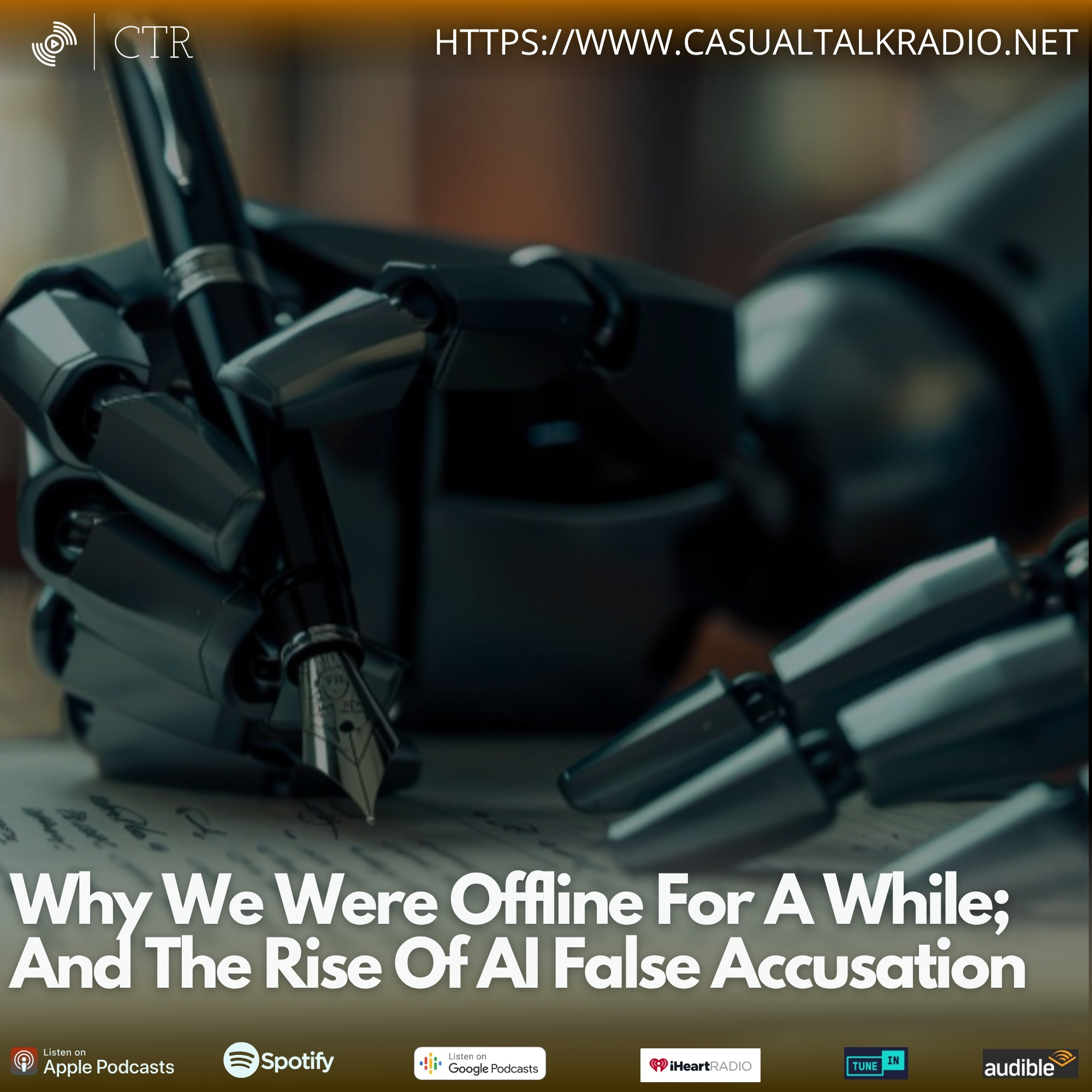
[00:00:30] I have not recorded in a while. There's a very good reason, trust me, it's a very good reason. But hopefully you'll understand after I share my story. I've got two parts to the story. First is the rant.
[00:00:43] Then it's the hopefully educational part.
[00:00:46] But let's get started with the rant and get it out of the way. Number one, because I want to get it out of the way, get it off my chest. Number two, it ties to in in a very key way. It ties to a giveaway. We're doing a giveaway of a Steam game, PC game for Death Stranding 2.
[00:01:06] And I want to make sure I get that up front because I understand some people are only listening for the giveaway. But I know I had some people reach out and they were enriched by the content.
[00:01:17] So I think I'm on the right track now. It's finding the right balance.
[00:01:21] That was not the reason I did not record for a while. That's the second half of the show. Let's get started with the first half, which is the rant.
[00:01:29] I am, I struggle.
[00:01:31] I'm not on social media, at least not exactly. I'm not on social media and I struggle because hopefully you're, you're hearing, I can speak, I can enunciate, look it up, words I can describe, I can tell a story, I can recite and I can remember even though I'm old.
[00:01:54] I have a lot of traits with respect to this type of thing. You know, speaking.
[00:01:59] It's been a trait of mine. It's not as I like doing it. I just happen to be good at doing it. Once I mastered the art of it back in school, you know, they would tell you if you were up having to get in front of the class, they would tell you, you know, picture everybody naked. That doesn't work. It just doesn't work because a, depending on who's in the crowd, you might get aroused. That rhymes. Or you might be disgusted, distracted. There's all sorts of reasons. You don't want to picture somebody naked. So I don't do that. That doesn't work. But what did work Is the reality that I don't care about any of these people and they don't care about me. Now, it's different in a podcast, obviously.
[00:02:40] CasualTalkRadio.net, it's a little bit different, but the concept is still there. You don't really know me. I don't know you. All you have are the stories I tell, and the story will either resonate or it won't. And I understand some people it will resonate. Some people it will not. It's. That's the rant.
[00:03:00] Because there used to be a time when people appreciated a good story.
[00:03:05] No. Now I actually had somebody come at me and say that AI would do a better job than doing a human analysis.
[00:03:13] We've lost sight of the appreciation for human analysis when it's done correctly. Human analysis done correctly is easy.
[00:03:23] Somebody is stating, here's what I see, here's the pros and cons, here's my impression of events.
[00:03:31] For example, this is not the topic, but, for example, what's going on overseas? Servicemen harmed in Saudi.
[00:03:39] Does it bother me? Absolutely. Servicemen being killed, does it bother me? Absolutely. Ukraine and Russia, does it bother me? Absolutely.
[00:03:48] Hormuz, does that bother me? Somewhat. Right. Iran, somewhat. There are things that bother me, but they are not. I understand the root of why these are happening and what people are trying to do. Whether I agree with them or not is beside the point.
[00:04:05] Some people will then rush to AI and say, well, AI, what do you think about this? Instead of having their own opinion? Because you can form, and you should form your own opinion about what you feel or what you think about these world events. This is the whole point.
[00:04:19] Many of these people went to college. And in college, that's what you were challenged to do.
[00:04:24] You were challenged to pick a topic and write an essay about it. And that had to be your own thoughts. You could not cheat, plagiarize, use automated tools. What's different? If we're having a regular conversation, casual conversation, you certainly should be able to tap into your own brain.
[00:04:39] The risk of people not doing it, you're going to lose the capability to do it. When it really matters, which is in the workplace and in your home, taking care of your family in the workplace, then people swear, well, tools like OpenClaw, which is one of these AI garbage tools, can just do all the stuff for you. All you do is call out your voice and it'll book your appointments and handle your emails and change your thermostat.
[00:05:05] They don't want to think for themselves anymore.
[00:05:08] They just Want to say a thing and have somebody else do it or some other thing do it.
[00:05:14] All the while they're losing the ability to critically think.
[00:05:19] So when they're dependent on these tools. So these tools obviously need to have Internet, they need to have power.
[00:05:25] And if you lose either one of those, you are going to be stuck. You're going to be one of the first ones out on the street, homeless, helpless, asking for help from our government, which puts a burden on everybody else. Because you were never, you were never taught and you never sustained the need to be self sufficient. Self sufficiency should be your priority. Anything that is technology based should serve the human, not the other way around and not to the degree that it replaces the human. For example, a thermostat where you say, okay, Alexa, increase it by 5 degrees or whatever the F. Right, Fine, no problem. Right. It's no different than pulling out your app and bumping it 5 degrees. So walk into the thermostat, bumping at 5 degrees. Or the camera, show me the rear yard or show me whatever. Sure. These are basic voice commands, not what I see people wanting to do, which is to basically not even have to mend the camera at all.
[00:06:25] The camera will just automatically call the cops when it sees somebody it doesn't recognize. Because you programmed it to recognize all your family members. No, at that point, you're losing the whole point. You. You are creating a burden on people. But this started to then spin over into regular speech, regular conversation, regular dialogue, online to the point certain forums on Reddit will actually have in their moderator rules. You cannot be an AI post.
[00:06:53] Now, that's subjective. That's my rant. It's subjective. It's subjective to say something's AI.
[00:06:59] People have been trained because they don't know any better and because they now lack the ability to critically think.
[00:07:07] People don't know how to recognize a post that's AI or a message that's AI versus one that's not. There are countless videos spinning up on YouTube of people who are tired of being accused of being AI authors. Somebody had a journal that they wrote over 70 years ago that they ran through the tool, and the tool swears that it's Chat GPT only because Chat GPT scanned that journal for its source data.
[00:07:33] But it was built at a time AI wasn't a glint in anybody's eye. Frankly, the Internet wasn't a glint in anybody's eye. So it's impossible.
[00:07:41] This other person who was responding to this phenomenon said, it's simple, folks.
[00:07:48] If whatever Content preceded the in, you know, the invention.
[00:07:53] It's impossible.
[00:07:55] AI didn't exist back then. It didn't exist and wasn't a thing two or three years ago. So if something was written or created five years ago, it cannot be AI But AI has scanned that content and raises false positives. But because people are dumbing themselves down and not forcing themselves to critically think, they're not thinking it through, so then these baseless accusations are being thrown. This gets very close. And this would be my passion plea. If there is somebody who has some sort of authority to write up a law.
[00:08:27] I think we're at the point we need to refine libel and slander laws to include any accusation of AI without any basis or fact or evidence.
[00:08:37] Because it's getting worse and worse and worse. You now start to trample on First Amendment rights because somebody tries to speak something and they get shut down because of an accusation that it's AI or my audio being accused of being AI Simply because it happens to be perfect speech at points. It's perfect speech at points because I know how to speak, because I was educated to learn how to do that.
[00:08:59] AI does not speak the way a human speaks. The only people who think that are people who have dumbed themselves down and can no longer critically think for themselves. Do you understand why I started with my concerns about the fact people are dumbing themselves down up front? It's because that is now opening the door for all these false accusations. And all that's doing is stymieing. Look it up.
[00:09:23] Real dialogue and real discourse between people. Because now everybody distrusts something that's well formatted. Something where somebody's well spoken. Even this one where the guy just happens to his face just happens to look a little bit too pretty. And so people thought he's AI and he had to come out and say, no, I'm not AI just the way I look. This is a bad time. And I'm stressing it's a bad time when we got people who accuse everybody and everything of being AI because they don't understand it. Because they have dumbed themselves down and no longer can critically think for themselves. You should not, and I'll say this to you as my call of action, you should not leap to the conclusion that something must be AI because of the following. And if you do this, you should change. I am asking you. It doesn't matter if you disregard me, that's on you.
[00:10:13] If any of these is true, you need to really think it through. That rhymes. Number one, if it's written.
[00:10:19] Just because it's formatted does not mean it's AI Just because they use bullets does not make it AI. Just because it's spelled perfectly does not make it AI. Just because it's perfect grammar does not make it AI. Just because there's two spaces after the period does not make it AI Just because it's perfectly structured paragraphs does not make it AI. If somebody's following the way they were taught as incorrectly and you just happen to be taught incorrectly, it doesn't make them AI. It means that you were not taught correctly to recognize how people are supposed to write. And it doesn't matter. I had people say online. Why are you doing that?
[00:10:57] Because the way somebody presents themselves should not matter whether you are online or offline or otherwise. You present yourself as a grown adult, not as a child. If you are 19 or 20 or greater and you don't understand why sentence structure matters, why paragraph structure matters, why bullets are important, why headers are important, why formatting and consistency and spelling and and grammar matter, you are the problem.
[00:11:26] You have to recognize these are important, and it has nothing to do with AI.
[00:11:31] You should understand these rules because you should have been taught these rules and you should not have disregarded them after you got out of school. That rhymes. You should also not be turning around saying that they no longer matter simply because it's online. Because we should not have a wall. Wall with. Simply because you were frustrated in school, it might have sucked in your English class.
[00:11:51] That's your fault. Not the tool, not anybody else's.
[00:11:57] But it got me thinking.
[00:11:59] Maybe people don't understand.
[00:12:01] What's the origin? What's the value? What's the genesis, as it were, of all this structure, of why we do those things? Because maybe their teacher never told them. Maybe their teacher never explained why it mattered. It is this that the Internet has sucked at roughly since its inception. There are tools.
[00:12:21] The tools are designed to assist a certain population of people.
[00:12:27] It might shock some of you who are all about AI and all about accusing people to be an AI and criticizing anybody who actually knows how to spell correctly. And those people who would rather shut down, censor, delete, or call out the word slop for somebody who knows how to write correctly. It might surprise you. It might surprise you to learn there are people who can't see, there are people who can't hear, there are people who can't speak.
[00:12:56] That might surprise you. You're saying, no, it doesn't. It must. Because if you understood somebody who cannot see, if Somebody cannot see, how the hell do you think they're able to consume content?
[00:13:10] Think it through again. You have turned off your ability to critically think. So you didn't think about that because you didn't care. Because you're only in your business because your phone and your social media has told you to focus on nonsense instead of what really matters. I'm going to explain it to you so that you can wrap your head around this concept. If somebody cannot see, that means they're not able to read the words perfectly. They might actually have some sight, but it's a blurry mess. They're not able to make out shapes of letters perfectly. They're not able to make out perfect starts and stops or paragraphs. They're not able to identify exactly what it is. I will say those people have every right to consume content no different than you or I.
[00:13:54] So it's wrong for technology to lead those people behind. As a result, technology has invented various accessibility tools to that are designed to help these people consume the content in their own way. If they cannot see, chances are they can still hear. And so many of these tools have technology, assistive technology designed to read the words to them so that they can still consume the content and even contribute with things like TTY or other types of tools that I won't talk about here. The point is that these tools that are assistive technologies designed to help read off the content for for them, the way they work best is well formatted content on an accessible set of code pages.
[00:14:41] If you don't write your application to be fully accessible, then those tools struggle. They can still try, but they struggle. If you don't use the proper formatting, the tools can't help read it in a way that makes sense and it might come across as gibberish to them and they lose the context. If you're using garbage words that don't make any sense and the context is lost because you're making up words like yeet and jeet or mid and you're making up a bunch of garbage words. Those words don't translate well to people who were educated through those schools because these are not real words in any known school educational curriculum that everything I just described is why you have to learn how to express yourself to not so that you can get your point across to people, but so that you can embrace people consuming it. You should want more people to consume it. Not just your friends, not just the group. Think of people who agree with you, but any and everybody who might want to stumble across your content and consume it. To do that, you need to embrace formatting. You need to embrace when it's a header versus body, text versus paragraph, text versus italics versus cursive versus bold, or whatever else according to the nature of the content. You should embrace bullets because it's easier to read them regardless of whether you can see or not. You should embrace proper line breaks. You should embrace. I actually think you should embrace two spaces after the period because it makes sentences more readable, despite what the Internet says.
[00:16:15] The bottom line is that formatting is critical not just for you, not just for being perfect.
[00:16:21] It helps those who otherwise are disabled and cannot consume your content if you do not do your part to help those people. So when people ask me why it is that I speak the way that I do, it's because I understand our podcast, CasualTalkRadio.net as well as all of our other ones. Not only are they transcribed so that they're in written form and made available, but there are also other accessibility tools that make our podcast available to those who cannot hear.
[00:16:51] So even if they're not able, let's say they can't read and they can't hear. But there are other tools out there that assist those population. There's not many of those where they can't do both, but there are other tools to help those. But it's important that you are clear in your sentence so that those tools can translate it into a form that they can receive that might be electrical signals or otherwise. The point is you have to communicate in a way that supports those tools. I communicate the way I do because I can never know who it is that's listening to me at any given time. It might be somebody who can hear perfectly fine. That rhymes. It might be somebody who cannot hear and I need to make sure the transcript is clear and clean. Might be somebody who is, quote, normal, as in they don't have any sort of disability.
[00:17:37] Or it might be somebody who has multiple disabilities.
[00:17:40] It doesn't matter. I need to understand.
[00:17:43] My presentation should appeal to the vast majority of those that are either listening or reading or otherwise. It is our responsibility to do that. If we don't do that, we are the problem.
[00:17:56] The summary of what I just said.
[00:17:58] AI can never replace human speech. People swear there will come a time when you will not be able to distinguish between a human and and the technology. I actually agree with them only because the current modern era, the younger folks, have dumbed themselves down, making it easy for AI to duplicate and replicate those speeches. But if you're A kind of person like myself. It is not as easy for AI to replicate the exact style, cadence, and most importantly, emotion and creativity. That is what makes us human. AI cannot. It can try.
[00:18:32] It cannot. The creativity is where AI fails. The creativity is where AI sucks and will always suck. No AI program can replicate true creativity because creativity is an amalgamation. Look it up of our life experiences and things that we've observed and things that we've heard and things that we've gone through. AI can only go off of things that it's been told, things that's been taught. Things that you're told and things that you're taught are. Are simply duplicative. Look it up of somebody else's experiences, which means it's a carbon copy that is no good compared to the original human. The original human is what makes us. We will never be able to replicate that into any sort of AI form, period. There will never be a person who acts exactly like Marilyn Monroe. There will never, ever, ever be a person who. An AI or person, frankly, who acts just like Prince. There will never, ever, ever be another Michael Jackson, technology or otherwise. You can argue a hologram. The hologram is simply playing audio over a backing track.
[00:19:39] I say these things because I want you to understand the importance of man, the importance of who we are, the importance of humanity. If you lose it or you try to run away from it, you are the problem. And I will emphasize that until I'm no longer here.
[00:19:54] Because hopefully the message resonates long after I'm gone. That's a hope.
[00:19:59] Am I optimistic? No.
[00:20:02] My rant is done. I'm finished. It'll come up again, but for today, my rant's done. Now the other half, which is the ultimate reason I have not recorded for a while, and I may not have. I think I mentioned this on an old, old episode. If you're new, welcome. But if I. I think I mentioned an old episode.
[00:20:20] One thing that I have an aptitude, look it up for is genealogy.
[00:20:27] You don't know what genealogy is.
[00:20:29] It is the science behind research around legacy for your ancestry.
[00:20:37] So we look, starting with either you or parents or whichever we can find and we trace back through time now. Now, some might not understand how the science fails.
[00:20:50] That's what I wanted to chat about because it's the reason, it's the ultimate reason I was not able to record when I wanted to, because I needed to spend time focusing on it. Genealogy is a very mentally taxing experience. It simply is. And I'm going to tell some stories here. In a second.
[00:21:06] But the struggle of genealogy is that your race, your origins, it's either going to be hard or easy, depending on your race. If you are predominantly, not exclusively, because nobody's exclusive, but predominantly white American, let's say Jewish, British, some of those origins, it is extremely easy. You can go back to the freaking dark ages if you want and you're going to find very clear names and definitions. Because a lot of those families through time did an exquisite look it up job of documenting family lineage. There are books that they would keep, family books that would document this person, married, this person, had this child or these 12 children or whatever, this person had this slave or these 50 slaves or whatever, this person what served in the Royal court of xyz. This person was born here, sailed over there, joined the military, came over here, married this person. They kept copious documentation around their family history because it mattered to them. The Native Americans, the five tribes, the civilized tribes, if you were able to find a lot of their documentation, you'd find things like interviews where they're documenting the question that they asked, the answer, so where were you born? You know, how do you feel that you're Native American? You have to get the name, they have to find the Dawes role. It's called out because they registered everybody with a number. It goes copious detail about the who's and the what's in the where's to be able to connect the dots that record information.
[00:22:42] It's a struggle to get all of it because some of it's online, but it's a struggle to get all of it because some of it's just simply not there for one reason or another.
[00:22:51] I'm not going to bore you here, but I do recommend for those that are trying to get back their critical thinking, mind you, I do recommend that you do some research around the Trail of Tears in the South. It's a very compelling yet sad story about what the government did to the Native American people.
[00:23:09] It's sad, it doesn't make any sense. But when you read it and you understand it, it starts to become clear.
[00:23:16] It wasn't just blacks, right? The Native Americans had their share of mistreatment. Theirs simply happened to be less of. But it was not.
[00:23:28] It cannot be dismissed, it cannot be ignored.
[00:23:31] And when you look at everything that was happening, then you start seeing blended marriages. You start seeing, you know, whether it's a. What's called a freedman.
[00:23:40] So in the Indian world, you may not have known, but some of the Native American tribes had slaves that were Black.
[00:23:46] And so when they were freed, they became freedmen. That's kind of how that works.
[00:23:51] You also had. Where Native Americans, they married, had kids with, let's say, white Americans or black American, it didn't matter. The. You had kind of blended lineage.
[00:24:03] When you start getting the blended lineage, given the times you're talking before the four, or let's say before the 50s, so 40s, 30s, 20s, right before that, you have to understand that these blended.
[00:24:16] These children born of blended marriages were not. They were shunned, they were not looked highly upon. And what you'd find sometimes is that some of them would just go straight missing. You couldn't even know what the heck was going on. There are stories. This goes to my ultimate story. There are stories of kids that were born from all of what's going on.
[00:24:37] They then are left with, let's say, a step parent. They grow up not knowing their real lineage. They don't know their real heritage. They don't learn it till later. They're grown adults. And they find out, however they do, that they're descended from somebody and there's heritage. Let's say Native American or black heritage. You could have white Americans who have black. That's why I said nobody's pure.
[00:24:59] There are people that are Hispanic somewhere in the lineage that there was a Mexican American brought over the border and they had kids at that. And a lot of people grow up and they learn this for the first time, or they have a theory, or they stumble across a document or something and they're trying to figure out what the heck does it mean.
[00:25:16] That's where I come in. So I have. I'm on ancestry and I help people. I've helped quite a few people where they come across some mystery or they're, let's say they're DNA related, either on one side or both, believe it or not, because that was the thing.
[00:25:31] Incestuous, look it up. Relationships were a thing.
[00:25:35] So I understand how it happens. We understand major families, we understand why it happens. And I help explain it to people to help their journey because they're probably much removed, if you know that once removed, twice removed, they're probably much removed, but there's still some blood relation upstream by a common ancestor. And so they'll come across me.
[00:25:57] And I had this conversation with my brother.
[00:26:00] Well, did you do the DNA? Yes. And, you know, he's hesitant to do it, which is fine. Not everybody. It's not for everybody.
[00:26:07] I did it mostly because I wanted to help people, because my DNA is a join It's a join between two sides. So it's going to come up as a hit for people.
[00:26:18] And by way of that, you get copious amounts of exposure to the two sides families. His concern is, well, sequencing.
[00:26:26] And I said, well, geez, you had a tonsillectomy, they already have it. And he, he just, you know, anyhow.
[00:26:33] But I had somebody reach out. This is why I went kind of silent for a minute.
[00:26:38] I had somebody reach out, pretty much in tears because. And I had talked to this person before, but they reached back out because an update was made on A site called findagrave.com find a grave is just like it sounds. And it made a statement that one of my family members actually was related to her, or at least that's what it said.
[00:27:00] And this meant that they had a brother. This, her mother would have had a brother, so she would have had an uncle that they never knew. And so they were really, really in bad sorts. They were, like I said, near tears because in their mind it's like, well, how can that happen and what's going on and what's the story here? And I had the most notes about all this stuff.
[00:27:21] So based on what I saw, I was able to, from what I could tell, from reasonable confidence, this has to be the same person.
[00:27:31] So I chatted with her and we were. She told me some more data and some of the information she told me about this, her grandmother, it seemed to correlate to this over here. And then she gave me a couple little tidbits that like, okay, that doesn't make sense. Okay, wait a minute. You know, things about abortions and things that didn't make sense, and it didn't jive with what I understood.
[00:27:53] So I decided to take another look.
[00:27:55] Now I had just to put in perspective why this started in 2021. Covid. Right.
[00:28:02] I was struggling financially. I was near homeless at a point. And so I had set up the show, the podcasts. I had set up other things and was working to try to find alternate sources of income.
[00:28:14] I wasn't going to charge for genealogy research, but I was. I was charging just in general for any consultation, and genealogies happen to be one of them. So I had started digging into my own and I stumbled across something else. I did more research than anybody on one of my master ancestors. And then as part of that, this other person came up because of this link that I'll tell you in a second.
[00:28:36] So I had collected all sorts of notes and photos and licenses and docs, and I, I was Confident I had it. It didn't make any sense because. Because this person, her grandmother, white, had a little bit of Indian ancestry, but was ultimately a white American.
[00:28:54] My, at this time, grandfather that I discerned, look it up. Obviously a black American. I didn't understand if he did or did not have any sort of Indian ancestry. I didn't. It wasn't part of my research. I just said, okay. Everything seems to tell me this is the, the same person that was married to my grandfather and would have been roughly around the time that he married my grandmother, which didn't make any sense. None of it made sense. But the dates correlated, the names correlated, the birthplace is correlated. I couldn't disprove it. That's the goal of ancestry. If you're doing it right, you're going to get a bunch of information.
[00:29:30] You have to disprove it. You have to find out a way to confirm that it's not true. If you try to take it on face, what tends to happen is a lot of false positives.
[00:29:40] The false positives are because of what I said before, which is again, you had cross blend families. You had incestuous relationships, but then you had master families like common names, Carters and Smiths, and just common names where it's the same first name, same last name, born in the same place, same birth year. And ancestry is not smart enough to kind of figure it out. Even its AI engine will get it wrong. It'll swear up and down something's true and you know it's not because you talk to a family member who produced evidence. It's not the same. So I'm saying, and the reason I started with the rant is AI is not a perfect science. AI is taking a guess. Just like any of the rest of us. We have to use critical thinking in order to figure out what's really going on. And we may have to talk to people, get the stories. Some of them are hard conversations to have, but it's the only way to really understand what it is with the information that we're seeing. Also, we lack the 1890 census. And if you don't know the story real quick, the 1890 census was lost in a fire. The building caught fire.
[00:30:43] They got the fire out and they could have salvaged records, but at the time, they made the decision just to destroy what was remaining, even though they could have salvaged them.
[00:30:51] So we completely lost those records. They waterlogged them, burned them, did the whole nine. So there is no 1890 census. So anybody roughly that was born, let's say 1880 or whatnot in around that area.
[00:31:05] That's critical information to understand where people were. It's critical to understand people's parents. It's critical to understand people's, you know, spouses or brothers, sisters. The census is probably the most valuable piece of information we have to try to solve that. Because if you have somebody with the same name, same location, same birth date, the only thing you can go off of is race, let's say, or brothers, sisters, or let's say some are in the tribe, so they may not have a regular census. And you have to go to the tribal records and then you find those, those differences. You say, well, wait a minute, this one by that name came out of Mississippi, but this one by that name came out of Texas. As an example. That's your hint that they are two different people. And it's the only hit you have. But you have to settle on it because then you're disproving it's the same person.
[00:31:55] So I had taken on face the reason I told that I took on a face that this person had to be the same person that married my grandfather for years.
[00:32:04] When this girl reached out to me and she's again borderline tears because her mother, the thought was, this is my, at that time, my uncle is essentially the child of this girl's grandmother.
[00:32:21] So it's family.
[00:32:23] And so because of Find a Grave and Find a Grave is just parsing the same faulty record data. So I took time and I wanted to go through it and just try to see, take another stab at it, given what she gave me, which I didn't have before, that required to have some hard conversations. I had some hard conversations.
[00:32:40] Everybody had the same story.
[00:32:43] It didn't make any sense because again, the docs seemed to completely debunk what was said.
[00:32:48] Well, after I chatted with her and I looked at the docs again and I went digging again.
[00:32:55] And then I found another document that I, I remember seeing back in 2021, but I disregarded it because it didn't make any sense. Because it's like, this has to be a fluke because the cause of death, I know this person is alive.
[00:33:07] But when I went off of what was said on all fronts, everything then linked up. I was able to connect dots through the story and determine this has to be the same person, same name, born in the same place, same year born.
[00:33:21] The main difference between the two is one had been in the area of the marriage and the other, I couldn't prove that that person had ever Been there. And I believe that she never had been. The location mattered because if you could not put them in the location where the marriage license was issued, it means it can't be the same person. Right? Right.
[00:33:41] So once I was able to confirm that, I did a write up and I had to clean up my ancestry. That took about an hour because it links all the records together. Parents, kids, you know, so I had to delink everything out, link this new person.
[00:33:53] There was no grave for this person. And remember, as I said, when a person is one of these cross blended, it was looked down on, it was frowned upon. We're talking the 40s. It was frowned upon to see that this person was had to be mulatto based on their ancestry. And we know that she was part Indian, I believe Choctaw, but I don't know for sure.
[00:34:16] So since we understood that she would have been mulatto, she would have been an outcast as so she would have not been embraced by either side. She would not have been embraced on the white American family or the black American family. I can prove she definitely wasn't embraced in the black American family. And at the time, the Juneteenth. So you know, you've heard the Juneteenth riots, right? The Juneteenth riots has extensive history, I won't bore you with, but during that time, some of the riots that were happening were right around that time related to the Juneteenth holiday.
[00:34:47] So what was happening at that time?
[00:34:51] A young white girl claimed that she was raped by a black man. And it caused a whole bunch of riots and unrest near some of the. Some of the bases down there.
[00:35:00] And so the dates didn't make any sense. Like, how would you have a white American woman and a black American man getting married right in the dead center of the riots? It didn't make sense. None of it made sense. So I was able to then say, once I found the other document, okay, this is a different person and she happens to have the same name. She happens to have been born in the same place on the same year. But it is a different person, different race, and the locations now I can confirm are distinct and different.
[00:35:32] So I put that right up out there.
[00:35:34] Haven't heard back from the young lady, but I wanted to put it out there to help put their mind at ease that it. No, it's not possible. It's impossible that this is your family. It's not possible. And what your grandmother had told you was true, because her grandmother had basically not said anything about it. And had gave a different story and at the time that story would have been a lie. If I couldn't disprove what was really going on, I was finally able to just prove it and hopefully that helped them reach some closure because I didn't, I didn't. When she reached out to me, she was really bothered by it. And I wanted to do everything I could to try to surface and again disprove what everybody was saying that I had to do a change request on find degree because it's just flat out wrong. Right.
[00:36:25] The moral of the story and the reason I told that A is that's the reason I went kind of silent, because I wanted to heads down, focus and try to solve this mystery. And it is mentally draining to do it. I didn't want to be distracted. But also I wanted to share.
[00:36:41] If you've not done any sort of ancestry research, I do recommend it, if only because the documentation that you do, the research that you do, the analysis that you do, it'll live beyond you. That rhymes. So you're also collecting information. Somebody else is going to come looking, whether it's a peer, family member or otherwise. Also remember that a lot of these people, whether it's you, whether it's your extended family, close family, whoever, a lot of times you have adopted people, you might have children born out of wedlock that are, you know, like secret kids, you have all sorts of situations that they might come looking, they might come searching. And any information that can help them find closure is not a bad thing. It's something I'll ask you to consider doing if you have not done.
[00:37:29] It's fascinating, but it can be frustrating, especially if you are black American or Native American.
[00:37:35] Those tend to be somewhat more frustrating than white American families. British origins, if you're Jamaican origin, geez, Jamaican's brutal. I had another person I was speaking to and she has Jamaican heritage.
[00:37:47] And as I close the issue with Jamaican is that the Brits, they came to Jamaica, they set up there, they took slaves. Jamaica did not arguably do hardly a good job at all of putting any of their record data online. So if you're local to Jamaica, you can go to some of their societies and you can look up on like microfiche to find some of the lineage records. But once you confirm that there is some Jamaican something, it's like a brick wall as far as online records. And the irony and the reason I was doing that is because the person that reached out to me said, well, we're DNA related. And I'm trying to figure out why And I, I did see it, it's a distant relationship. But she said no, my family's origin is Jamaica and I ancestry has no, it doesn't believe that I'm based out of Jamaica or that any of my ancestors came from Jamaica.
[00:38:41] Well, if that's true, which I again cannot be by what I found, if that's true, then how is it possible that I can be being related to this person? And what happens is that these slave owners that take slaves then born kids and they're way up there like in the 1700s or something, you'll get these remote matches or sometimes you get a match that's a false positive and it's so small of a sample. But in this case it was close enough that chances are it's a slave owner had a kid with one of the slaves, that person then went somehow got to the mainland, somehow something happened, etc. I think I found that one of my ancestors was went back to Jamaica, got married there and presumably had some sort of a kid and somehow that's what the bond was. It's fascinating stuff. I do encourage you, if you have not done to take a look at it and get involved with that. But in everything that I described, if I do go incognito understand it's there's a reason, it's because there's something I got a heads down focus on and it's difficult to try to balance multiple different things. It's not because I don't want to do it. This is still kind of a passion for me because I like doing it. But there will be times when I have to go radio silent. My commit to you is to do a better job of practically telling you when I can anticipate that that's going to happen.
[00:40:02] Hopefully between again the rant and the educational for the genealogy, hopefully that's all been informational and somewhat I've helped reach some. With regards to critical thinking, it's important that you rely on yourself and not on technology. Don't rely on technology to do things for you. Understand how to do it so that you understand when tech gets it wrong because it's going to get it wrong every single time. And if you don't know how to do it yourself, you're blindly trusting faulty logic. And if you trust faulty logic, it's risky. It's security risks, it's financial risk, it's safety risks. Don't do it. It's not worth.
[00:40:51] Oh.