[00:00:00] Foreign.
[00:00:05] You're listening to casual talk radio where common sense is still the norm whether you're a new or long time listener. We appreciate you joining us today. Visit
[email protected] and now, here's your host, Ler.
[00:00:22] Welcome back and thank you for listening to the show Casual Talk Radio. My name is Leister.
[00:00:27] We had a, we had a weird set of weeks here.
[00:00:33] Leister called, he predicted the future.
[00:00:36] If you didn't hear last week's podcast, shame on you. Seriously, welcome, by the way, if you're new, but you should hear last week's podcast episode. It was I, it was eerie and ironic both.
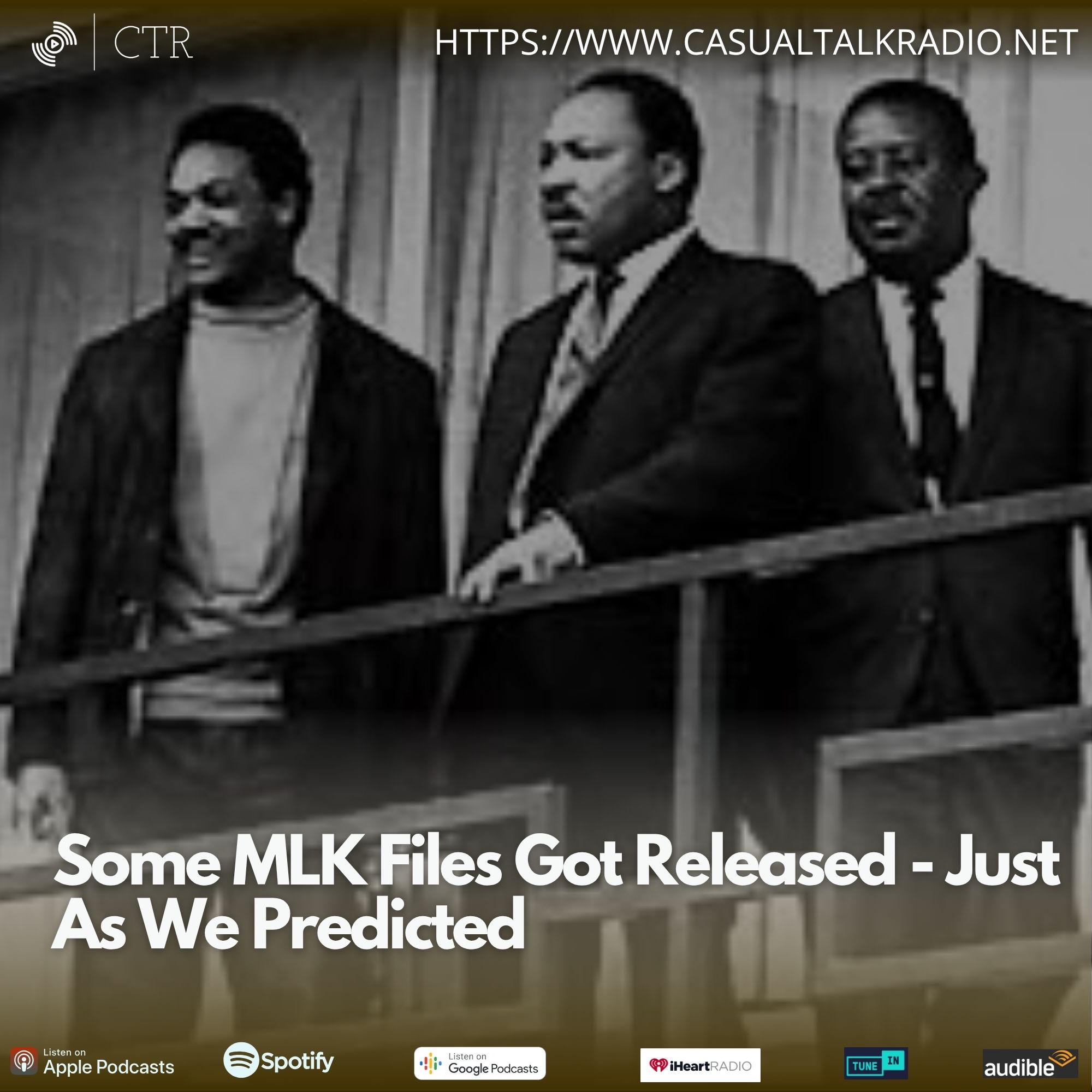
[00:00:49] I said in response to this whole Epstein business that the White House would do a Chewbacca and I called out the release of MLK files. I wasn't even serious, but I had a theory. I mean, it's like, what else is left? I just figured that there would be something else released as a Chewbacca distraction away from the Epstein Chaos. And wouldn't you know who won the pony? White House released the mlk, at least specifically the assassination FBI investigation of the assassination files.
[00:01:23] Now, some may not have followed or cared. I think you should care. But some may not have followed the whole story of Martin Luther King. Okay, so Martin Luther King, this all went down in the 60s, late 60s.
[00:01:39] He gets assassinated. He's at the hotel. He's out on the balcony there. He had just arrived. He was going to be basically protesting with some striking workers because he had gone from, I don't want to say radical because that's not the right word, but he had gone to kind of this, this from this extreme leaning approach.
[00:02:05] And there's a notable interview with him and Muhammad Ali that talks about this when Ali was refusing the draft.
[00:02:12] But he had gone from that and he had shifted over into kind of backing blue collar type of things and doing what he could to keep his face out in the public eye and support the lesser classes and try to still promote his desegregation messaging.
[00:02:32] Now, I want to go a little bit deeper into this, but just FYI that he gets assassinated in the late 60s. He's standing on the back of the hotel.
[00:02:42] James Earl Ray was outed as the assassin said that he was standing in the bathtub. He was, he rented the room across, stood in the bathtub, shot through the window. One shot took out. King was seen fleeing the scene, left behind a rifle with his prints and everything on it. They found him guilty, served 99 years. He died in 98. So he's not alive. But he had initially admitted to the crime, which is why people just kind of let it go.
[00:03:11] Later, when he apparently had an issue with his attorney, felt that he didn't get the right representation.
[00:03:19] Also, he thought at first, and the reason he took a plea deal was he thought that he was going to get the death penalty.
[00:03:25] Turns out that during that time, he wasn't not going to get the death penalty. It was not allowed in the state where he was caught up.
[00:03:34] Then George Wallace, who. I did an episode a little while ago about talking about George Wallace, who was at the time completely against desegregation.
[00:03:47] And I talked about how George Wallace, he cut an interview where he's basically saying, look, you know, we had to do what we needed to do. This is what are the people who voted us into this wanted us to do. You know, segregation is what the people wanted at the time.
[00:04:02] So then now the whole six degrees of separation concept. Yep. You get this James Earl Ray, he takes this 99 years.
[00:04:12] He doesn't appeal. He's trying to get out. He recants his admission, and he's trying to get out. And he's hoping that George Wallace, who's going to come in here soon, will let him out. Well, never happens. He dies in prison, does James Earl Ray.
[00:04:28] There were conspiracy theories that King was taken out by the governments in the United States. So part of the problem at the time, and I talked about this on the. On the George Wallace episode, but part of the problem with. At the time, with desegregation, is Wallace was correct in the sense that segregation was what the people actually wanted. I would argue that in some vein, segregation is still what people want.
[00:04:58] They're just ashamed to admit it. But if you think about how, let's say you go out to some, you know, communal something, you'll see people of the same race congregate together just because what they do. Churches, you'll see churches that are predominantly one race, depending on the church and depending on the domination.
[00:05:14] It happens all the time. You see movies.
[00:05:18] Movies are usually aligned towards one or the other in neighborhoods. You see that they lean generally a specific, you know, demographic that's. It seems like it's endemic in our culture. And then we try to force this unification, this kumbaya approach where we were busing, right. We were forcing integration. We were forcing things to come together. And I once speculated that that whole situation of forced integration was really more about money than it was about the right thing to do. Because again, society does not seem to welcome.
[00:05:55] Does not seem to welcome desegregation at all. It seems like we have still preferred segregation as a culture overall.
[00:06:04] And I never quite understood it. You know, I've me, I've been the kind of person who I find other races, generally speaking are intolerant.
[00:06:16] I don't want to say that they're racist, although some are, but it's more intolerance.
[00:06:21] But the intolerance really goes to. I learned later in life that the intolerance really goes to perception.
[00:06:28] Judgmental people will look at the way you act and behave and dress and they make a judgment call. And that has less to do with your race and more to do with how you carry yourself. That unfortunately is more likely for certain races to act certain ways. I just saw there's this fat girl and she's walking around and her belly's out and you could tell she was trying to go exercise. There's an appropriate way to wear, you know, you should probably wear sweats that are fitting of you because clearly hers were not and she was well endowed up top. But she's fat and she's putting it all out there. Well, that makes you look not appealing. It doesn't. It does not put a positive image on the neighborhood. People might say that's judgmental. Yes, that's my point. We can look at that and say, you really shouldn't do that. And if I look at other races, they're not doing that same.
[00:07:21] That's the problem. That's the narrative. That's the conversation.
[00:07:24] So when this whole thing happens with King now people speculate that the government was involved in taking him out because they were trying to.
[00:07:35] They saw that he was a threat to the segregation that they allegedly were trying to support. And that there were theories that the government ultimately worked together with some of the, the very people that he was marching with. And I think this is wild eyed, but some of us marching with to kind of get him into a false sense of confidence.
[00:07:57] That was the theory going around.
[00:08:00] Now I saw the files that were released. There's a lot of them. There's, there's hundreds of thousands of files. There's no way you could read all of them. But I did see the files and the, his children and grandchildren were completely against this release because they're all talking about the Epstein files.
[00:08:16] It was his niece that actually worked with Pam Bondi to, in support of this release.
[00:08:22] I said at one point that, and this is an older, older episode about why aren't we releasing the MLK files. So I support releasing the MLK Files. I don't think these files are to do anybody any good. I don't think we're going to see or hear anything that's of any revelation. The files that would tell us something of any use allegedly, are still sealed till 2027. These would be the files that dig into MLK himself.
[00:08:48] You know, rumors that he was cheating on his wife and he was running with hookers and drugs and all sorts of stuff. That. That's what the salacious stuff. Not because you want to ridicule with a man, but you need to understand the truth about who he was as a person. Then everybody can make their own judgment. That's. That's what I was interested in, hoping to see, what I could see. These, I think, are going to be dry. From everything I saw, they're reasonably dry. Do I think that James Earl Ray killed him? Yes. Do I think there was some larger conspiracy? Yes. Do I think that the government did it?
[00:09:22] Maybe. Or more likely, the government didn't do it, but the government was kind of looked the other way.
[00:09:30] Somebody else set it all up. Could have been mobs, right? It could have been anybody set it up, but the government looked the other way instead of protecting him.
[00:09:38] That's more likely of a story that the government just basically chose to look the other way. We know that J. Edgar Hoover and others were just not on the right vein. We had a lot in government that really were not on the right vein and were not the right types of people to be in that office at the time. But it was a different time where such things were tolerated, such things were normal. And so we look at it now. We say, well, how can these things happen? They happen because it is correct what Wallace said, which is that society was tolerant of that mantra. And what King was doing went against what most people believed.
[00:10:13] The people that marched with it, the people that supported him, the people that were behind him, you know, we shall overcome, right?
[00:10:21] Hoping for a different, you know, world. Sam Cooke, change gonna come. All of these messages were. They were a plea, right? That they're a plea of people that were trying to push for a different world. But think of the people that were pushing that message. Sam Cooke gets shot in a hotel, allegedly with a hooker, in cahoots with. With the person that ran the business. And then Martin Luther King gets shot at a hotel. The like, you know, Malcolm X gets taken out. Like, you think all of these people that are pushing that kind of message, and they all just get taken out in very dubious circumstances. I'm trying to say that. Not that mantra of segregation. There were people, and arguably they were the majority that supported that over desegregation. Desegregation was a threat in a lot of people's eyes. They did not want to see a change to what they felt was the comfortable way of things going, despite. Does that mean that we should not have changed? No. But I think I believe myself that we went a little bit too far in forcing the narrative. Part of the problem in the workplace, too, but also in society and everywhere else is this idea that we have to try to force things. Right. We have at work, we have meetings where we have to force everybody to agree. And we sit there, waste time until we can convince somebody to agree. We can't just accept somebody's going to be angry. We walk out of this room, and that's okay, because if they're angry, walking out of the room, either they have a valid point or they don't. If they have a valid point and they don't make it, they have no right to say anything about it. We just live with that. Instead of trying to make everybody friends, instead of trying to make everybody happy, instead of trying to make everybody calm, stop trying to force things on people and understand some people are not going to go along with it. And you simply shrug it off. We have. We refuse to do that. And I think at this time that we're discussing that was this. That was the case. There was a refusal to accept that. So there's a resistance when it's being pushed and it's being forced, especially with the busing and everything else. Look at what happened.
[00:12:27] If you don't believe what I'm saying, look at what happened with the schools. The quality of schools and the quality education sharply declined when we integrated.
[00:12:37] Not because of black people. That's the myth. What happened is when you integrate, you're not accommodating the specific nuances and needs of the different races of kids. They have different levels of education. People that come from Asian countries, by and large, I'm talking when they come from those countries, by and large, are already at an advantage over the people. United States, they're educated much more strongly than we have been. We know that to be the case. So when they come here, we're kind of dumbing them down. If you're honest, we're kind of dumbing them down.
[00:13:12] So. And we see kids that struggle, and there's a pattern to the kids that struggle versus the kids that don't. Well, what do we do about it? We don't do Anything. We just kind of shrug our shoulders and we point the finger instead of acknowledging that we caused that in the olden days when we did have segregated schools, one thing you could say is that the kids were getting the care and time and attention that they really needed for their unique, specific circumstances. And. And that's been lost.
[00:13:40] So I'm saying a lot of what we pushed away from from back then, we're no better off now than we were back then. We. It made people feel good. But we have to look at the quality of education.
[00:13:53] We have to look and see how much harder is it for people to get into housing than it used to be. How much harder is it for people to own land than it used to be. How much harder is it for people to be accepted in the neighborhood. How much harder is it for people to embrace their neighbors. Everything is much more difficult when we force this integration narrative because all it did is create animus on one side versus another. It's us against them because people didn't want others in their neighborhood. And then you have this upscale neighborhood and they don't want this, you know, African American family moving in there.
[00:14:30] Okay, you force that, right? You redlining, okay? So you change it to where they're allowed to be there now.
[00:14:36] And you're basically forcing them to tolerate those or those that don't want it. They just move away. And then that kills the property values and et cetera and so on. It has a downstream effect. I'm not, again, suggesting that we should not have changed anything. And I'm not suggesting that King was wrong. I'm not suggesting any of this. I'm saying that when we look at the MLK situation now, now that we have a little bit more information about the assassination and everything and the theories going around about a government conspiracy to take out King, I don't believe that they took him out. I do believe it's possible they might have looked the other way while other people did, because they might have seen that basically, it's up to society. Society is not going to. They're either going to accept him or they're not. If they're not going to accept him and something happens, we just won't intervene. We won't step in. James Earl Ray then becomes a fall guy because he admitted guilt. I don't think he admitted it under duress. I think he admitted it because he, by his own admission, said he wanted to be famous. That's what he said. So he just. He was young. He didn't understand.
[00:15:40] You're Doing this wrong, sir, if you think this is the right way to become famous, you're doing it wrong and you're going to regret this. And he later did regret it and then he took that regret to his grave.
[00:15:51] So I do encourage, if you are, if you do have some free time, none of us do. But if you do, check out some of those files. They are a little bit dry, but there's some interesting photos and things in there that. It's not going to change your mind. It's not. If you believe whatever you believe, it's not going to change your mind. It's not going to make you think differently than the way you do. That's not what it's for. But I do encourage you, as a call to action to keep an open mind about Martin Luther King and what he was pushing for and society overall and whether we are truly better. Not that we feel better, I'm talking better off, right?
[00:16:25] Financially, spiritually. Are we better off spiritually? I would argue no. In my opinion, no. Because think of what we have. We have churches that now the churches have to fight to be churches, right? To, to maintain tax free status, to entertain, you know, members and entice members and, and sustain that. They're struggling compared to what they used to. So are we really better off? The school system I just talked about, are we really better off? The workplace we push all these things that basically force companies to consider multiple races.
[00:17:01] I understand the thought, but are we really better off? I would say no, because most of these races that are disadvantaged, it's described as are they really better off? No, because then we had to create these programs that are designed to take care of them when they can't get a job. I'm saying there's a case to be made for the narrative or the theory that there was a conspiracy against King and that. That I'm leaning towards the boat that the government did not take him out. But they probably looked the other way even though they knew somebody else was going to go after him. They chose to look the other way while it happened and accepted James Earl Ray's admission without fighting it. Like I think they just roll along with it because it helps solve a problem for them. You don't think of it as a problem because you're looking hindsight. But at that time it was a big problem for them. The idea that this messaging about desegregation was starting to spread. And again the George Wallace tells the story about how voters thought they did not want what was being pushed on them. They didn't want to hear about integration and forced integration and their what they saw was violation of their rights and violation of their, their ability to basically be isolated Right So I say it's a good read I say it's good to be up to speed on these things I think it's an interesting thing it's still a Chewbacca of him describe distracting against the Epstein files bottom line and it's not the files that I think are most interesting to read which are the ones about him specifically but it's still something to educate yourself get away from social media for a little while learn a little something you know because these are these have been hidden for decades now Decades and we have to ask the question why were they hidden in the first place? Why were they locked away?
[00:18:49] Not because I don't think the government killed the man but because there was something about him that certain people didn't want to get out.
[00:19:01] Oh.