[00:00:00] Speaker A: Foreign.
[00:00:05] Speaker B: You're listening to casual talk radio where common sense is still the norm whether you're a new or long time listener. We appreciate you joining us today. Visit
[email protected] and now here's your host, Ler.
[00:00:20] Speaker A: Oh, if I only had the time.
Thunderbolt Patterson. If I only had time.
But I am going to do my very best to do justice for an episode that I was excited to cover on a person that larger than life that I don't think the modern understands.
I think the demographics of the show lean old enough that you would know, but maybe not everything.
So I'm hopeful that you get something out of this and I encourage you to dig deeper into what this is all about because I felt like when I was doing digging there was so much I didn't know because our education system did not and does not emphasize characters like this. I, I talked on an old episode and if you're new, by the way, welcome. But on an older episode I, I mentioned that I was in a program in junior high middle school for some of you older folks and I had what they refer to as a mentor. He wasn't really a mentor, but a mentor with specific intent for young African American males.
And they refer to this as gq. This is still a program. You can search this gentleman of quality, this guy's name is Mr. Harley.
And they would basically take a slice of class time for us to be supplemental taught by this thing and learn other stuff not taught in the main curriculum.
Now I saw no value in this whole thing when I remember at one point we learned about Meryl Streep.
There's nothing wrong with learning about Meryl Streep, but for something that was supposed to be around African American men, I found it rather odd. We didn't really talk about some of these larger than life African American figures across history.
I can't even remember ones that we specifically did talk about. There's so many of them.
And then I would learn later about so many more.
It just frustrated me to see the decline of this coverage. And I would argue that a lot of that decline runs lockstep with the demise of certain magazines like Jet Magazine. If you don't know Jet Magazine, most people do, but if you don't, Jet Magazine was a small magazine ran. I don't know if it started in the 60s, but it ran a while ago targeting African American culture but not exclusive to it. And then later they just died after it's bought and transferred, etc. But Jet magazine I thought did A great job showcasing a lot of this. If you were able to see it in like the 70s, I think it did a fantastic job of spotlighting certain of these figures. It couldn't cover everybody because there was so much to cover.
But I think if you can get your hands on some of the digital copies of it, it's worth that journey. If you're curious, one of them from the 70s, it profiled John Lennon and Yoko Ono. And Lenin was talking about. And there's stories about this, but Lenin was talking about how he and the other, to a lesser degree, the other Beatles were influenced by black culture. You've heard the story about how Elvis was influenced by the church and to a secondary degree, black culture. We know that, right?
We know that Jackie Wilson was an influence on a lot of people. We know that Sam Cook was an influence on a lot of people. We know that Little Richard was an influence. Ike Turner was an influence on and on. We know that there are certain in music that were influenced. There were certain in media that were influenced.
Well, Lennon, he talked about so many other black. I'll say black celebrities, Black American celebrities.
B.B. king, right? Chuck Berry just beasts in. In music. Albert King, Mary Wells, it.
You might not know that Mary Wells.
There was a time when the Temptations were doing backup for Mary Wells. That's how big she was at the time.
Mary Wells was adored by the Beatles. That's how big she was at the time.
I talked about Little Richard. Bo Diddley is another one, Lead Belly is another one, T Bone Walker's another one.
But what I didn't know was how Dick Gregory was an influence on John Lennon. And actually Dick Gregory was friends with Yoko and John Lennon.
This is, this is on the 60s 70s time frame.
I also didn't ever know that Dick Gregory had ran for president. A failed bid to run for president.
I had known that Dick Gregory was a comedian.
But when I learned more and I dug more, it occurred to me and I make the statement and I know some people will get triggered and I'm hoping that you will listen to what I'm saying and resonate to it.
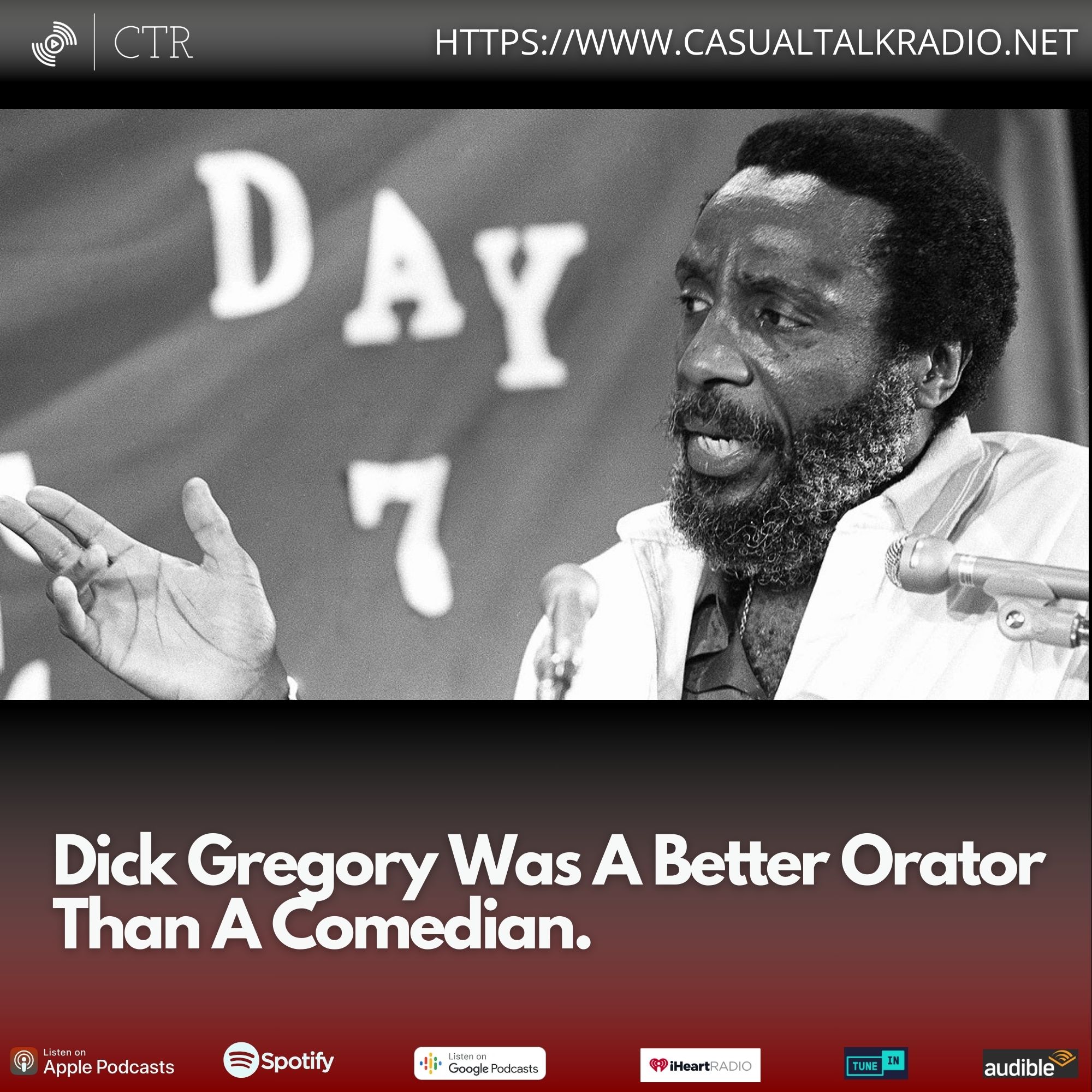
Dick Gregory was a better orator than he was a comedian.
What do I mean?
Dick Gregory would say things in his standup that I found not funny. I. I frankly did not find much of that funny. There was a couple things, but by and large I didn't find them funny.
He would then do kind of what Dave Chappelle does, which is he would intersperse, look it up, real stories as part of what his standup routine was he would tell real compelling stories. Some of them were not lies, but they were a little bit embellished, I guess is the best word to put it, but they were still factually accurate.
And, and I realized that at some point, and I believe this is roughly in about the, roughly about the 70s, early 70s timeframe, maybe late 60s.
It seemed like he mentally kind of shifted. He, he saw things needed different attention than what he was doing.
And there's a story that goes way back about how the FBI was alleged to be doing a cover up on three people that were killed. And it was really Dick Gregory that was arguably responsible for pressuring the FBI to tell the truth, you know, expose that, you know, these three people ultimately were, were murdered.
It's a whole big story. And I do encourage you to go take a look at this, but it involves the Klan, it involves J. Edgar Hoover. There's a whole big thing about this where, in summary, the FBI was kind of flip flopping, saying that it was probably, you know, maybe there were just nobodies that got killed by somebody or, you know, fled somewhere or something's. It's not what you think it is.
Don't worry about it.
But they were, the, the message was there were all these bodies, black American bodies that were being surfaced, killed, and these three in particular that went missing.
Dick Gregory finds out about it. He's out touring, he's touring international. He finds out, he comes back and he's like, okay, what's, what's happening here?
He discovers, okay, chances are These people, these three were killed. This is in the mid-60s, allegedly, and I don't know what the full is, but allegedly.
There's this interaction happening with the police that doesn't really go that well where, you know, Gregory's really adamant about the FBI needing to come out and tell the truth about what's happening here. Hugh Hefner's involved.
Hugh Hefner.
So all the criticism that he got when he was alive, right, but Hugh Hefner's involved to try to support what Gregory's trying to do. And eventually Gregory gets a tip about where the body, the other body, these, these three are, are found.
He gets a tip, he talks to the FBI and FBI says, no, it's fake.
The, this tip is fake. But they don't question that location. Eventually with the pressure, they say, okay, we, we admit that we were kind of holding some stuff back.
Now it's like, well, wait a minute, how come you were suppressing it in the first place? This is the one moment, I would argue that kind of set Gregory off on. He was already involved in civil rights, you know, because the Civil Rights Act. Right. He was already kind of involved mentally. But I think this is where it set him on a path of his messaging changing gears.
He would do some stand up later when he was older, but nowhere close to what he was doing as younger. Everything now was a much more serious message, much more targeted. Again, Dave Chappelle would do similar stuff, but nowhere like Dick Gregory would do. Dick Gregory, of course, was born in 37. He died. I think it was 37. Died in 2017. That much I know. Actually born in 32. Sorry. And then died in 2017.
So he lived a long life. He had. He had been diagnosed with lymphoma at a point as a youngster. He was sick quite frequently. He had gone to schools that were for kids with disabilities, and he had a kind of a rough young life. And then he was dealing with a lot of stuff as he came up later. Then he was presented as, okay, we see what's happening here.
You might remember that I talked about the question about segregation and the question about George Wallace, right. And how he got attacked because he was supporting segregation early on. And this talks again about the whole comedian, how he blended his.
Part of what he would say is, you know, about segregation wasn't that bad.
But he was talking about in joke form, right.
In segregation, which wasn't really segregation, but it kind of sort of was the idea that, you know, blacks had to sit in the back of the bus.
And the joke he would tell would be, you know, how can segregation be bad? By sitting us in the back of the bus.
If there's a collision, people in the back of the bus are less likely to get hurt. Now, that's obviously not true, but he's turning something into part of his set.
But he is kind of serious in the sense that he's talking about how sometimes there's safety in what that's doing, and that ties to what George Wallace is trying to say. That was poorly said, which is the idea that his constituents supported this narrative of segregation.
Later. Then I saw a standup from Dick Gregory, and this. I think this had to be. I'm going to guess somewhere about early 2010, maybe.
I'm guessing maybe mid 2000s, but I'm thinking early 2010. But he said something that was really compelling. He talked about how white Americans. So he's talking about white Americans in general, but he focuses then this around white American women.
And he's Saying that white American men were really the problem all along.
And it took black Americans through the civil rights and other things that were passed.
It took them to get certain rights granted to them and freedoms granted to them in order for the doors to open for white American women. Because of course, the suffrage right movement and other rights came after.
So fresh off of the Civil Civil War, fresh off of Civil Rights act, fresh off of all these transitions that are happening specifically catered around black Americans.
Not just freed slaves, but also just regular ones that did not have the same level of rights. You know, certain states that were doing redlining, certain states that still supported discrimination, you might have been free, you could own property, but they would do it in a way that would segment you rather from the population, purposely at the banking, right? The banking could discriminate against you, jobs could discriminate against you.
What he's saying is that everything then was focused around black American males to the detriment of everyone else for a period of time. Then it was white American women that got their rights later. But they in some ways have to give some thanks to black American men. And he specifically targets men because he's putting it together.
Because really it was all women, right? All women were being suppressed. At a point, you know, you were expected to basically just be home and that's it. You really could not hold down a job. It wasn't just about voting. You couldn't hold down a job. At points, you could not vote. At points you were expected to just do what you were told and be nothing more than that. Some were not allowed to be educated.
He's saying that all of that, if you look at the common thread. I'm paraphrasing what he's saying, but if you look at the common thread, white American men were really the problem. They were the problem. When you looked at the. The Trail of Tears, Native Americans, when you look at how white American women were suppressed for so long, and then black American men had to fight and march and do these things to get more rights. But then they were the first. They opened the door for others to gain those rights as well. Which is true.
All of that's true. But it's compelling to think about it. It's compelling to think because in the modern. So I'll fast forward now to the modern.
And Gregory predicted this. But in the modern, you think about the animus that goes in society where there's this contentious, especially when Obama got elected, arguably you have this contention where it's like whites against blacks or, you know, whites Against Hispanics or whatever, Asians, just kind of off to the side.
But a lot of this is. Well, you see, black Americans are getting what seems like preferential treatment by way of dei, which I did an episode about.
On the flip side, black Americans feel like there's a systemic racism against them, which in some ways there is, although it's being misrepresented. In some ways there necessarily is.
The opportunities are nowhere near equivalent, but the reason that they're not equivalent is because the education was not equivalent, had not been. Arguably still isn't.
And Gregory does an interview. There's an interview out there, it's about five minutes long, where he talks about where he was coming up in school and how it wasn't equal because of the situation that his family was in and the way the school treated it, which was. Everything kept going.
I wasn't given any help. You know, I'm out sick for two weeks, I come back, they kept going. They weren't trying to help me. Right. He's telling the story about how he really had to fight and he was able to overcome that, but it wasn't like anything was put on a table for him.
So I'll intersperse my own story to that so that you understand kind of why I was so excited to do this one, because there's parallels in mind versus what he was talking about.
So in school I was the furthest thing from an overachiever, arguably elementary. I would say I did decent good middle school. I certainly did decent good high school. Absolutely not.
The thing is, it was never about capability or capacity. And everything that you hear from me now arguably came from a desire to keep reading. When I was younger, excessive reading, just reading books and books and books and books. I couldn't get enough of reading books. I would argue that was the strongest motivator for how I speak to a secondary degree.
I think television did a good job, especially shows like Star Trek.
Movies, not so much, but it did have at least some.
But certainly books and certainly television, at least the good quality. Obviously the quality is terrible now, but back then I thought it was really good quality. And listening to people, certain people, you know, Patrick Stewart, Sir David Attenborough, etc, that were good orators and absorbing and understanding context clues is something that you learn in school.
When I got to middle school then, and I'll never forget it, but when I got to middle school, I had a teacher, it was math class, and she actually put a.
A problem up on the board and she calls on me to answer the problem. Boom. I answer it.
[00:19:01] Speaker C: Wait a minute. How'd you get to that answer?
[00:19:04] Speaker A: Like what?
[00:19:05] Speaker C: How'd you get to the answer?
[00:19:07] Speaker A: What does it matter? Is it right or not?
[00:19:09] Speaker C: It's right, but you need to show your work.
[00:19:11] Speaker A: What do you mean, show my work? What are you talking about?
[00:19:13] Speaker C: You show how you got to answer.
[00:19:16] Speaker A: I never, ever, ever understood.
So then I'm. I'm breaking it down. I never understood, but I broke it down. This is how I was taught. This is elementary school that I'm breaking down. And she's criticizing it because the way I was taught are the shortcuts to get to the answer. It's. There's quick ways to do math to get to the answer such that it doesn't. You're always going to get to the right answer with these tricks when you learn them. My understanding is they stop teaching these tricks.
But I was always taught the shortcut to get to the answer because it ensured you always got to the right answer the way we were taught then in elementary, just to kind of put in perspective. Let's take multiplication.
Everything was visual. You would show visually how the multiplication worked. We would get an assignment in class. She would play a tape that just played loudly on repeat of how to do the different multiplications. It just goes in the multiplication table.
We all get our fix when you multiply by six.
The point was as corny as it was.
The repetition, the simplicity of it, and the visuals of it made it stick. It made it stick such that it was easy. Once I was able to get the numbers understood, which is also elementary. And once you understood the tricks, you know, divisions is a variation of multiplication. Right.
Once you understood multiples of five, multiples of three. Right. Once you understood the rules, the rules of it, everything in math got easier across the span.
So this teacher, in their mind, you have to sit there and write out a full page.
And I know everybody knows what I'm talking about. You got to show that you're carrying the one, and you got to show that you're putting a slash through the zero and putting the nine up above it.
That's, you know, that's how they want you to break it out. Why?
Because in their mind, in. In the curriculum's mind, every student should do it the same way.
That's what school's critical flaw is, forcing students to all do it the same way instead of encouraging solutions that get you to the answer. Regardless of how you get there, if you do this, you're always going to get the right answer. Because when you get to the workplace. That's what you're expected to do. You're expected to solve problems and take minimal time to do that.
And it. And we have calculators, we have computers, we have all these things. We had calculators when I was going through an elementary school, but we never used them because we never needed them because the math was too simple for it. We would write it out, but we didn't need to write full pages of stuff like middle school, where we did have calculators. It was stupid.
And then of course, what they would ban calculators during tests, which made no sense.
School as a curriculum focused on every student should do it like this. Every student should follow these steps. That rigor was the antithesis of who I was and who I am because I'm a solutions person and I'm creative. The creativity was my greatest strength back then. It still is my greatest strength. My strength never was following that kind of rigor because we understood as students that there's always going to be a problem where that solution's not going to work.
But if you always focus on an outcome, you can get creative with how you get there.
Which is why I was disheartened to hear the demise of wood shop and auto shop and electric shop and all these creative things. I took art in high school now and then. I'll get back to Mr. Gregory. I took art in high school.
The teacher I had. I did a painting. And if you know Final Fantasy the series, you understand what a moogle is. I did a painting. If you know Final Fantasy 3, which is otherwise known as Final Fantasy 6. The COVID of that game, which I'll have somewhere at some point. But the COVID of that game, you can search, it has a moogle.
I painted that cover. I did it so well, surprisingly so, because I didn't think I could pull it off. But it was. I thought it looked great. Every other student that looked at it thought it looked amazing.
The teacher gave me a D because he didn't like it because he was judging something. My brother who passed away and 2023, he was going to go up to the school and beat that teachers.
You know what he even said? I remember the conversation. He was loud. It's like, no, you can't. You can't grade art like that. And you can't do that to kids like that.
Because it's true. That's the flaw again of the school system. The school system wants you to do even art, even creative things. They want you to do it a very Specific way. And if you don't do it their way, it jeopardizes your future because you might fail high school. At the time, the high school diploma was your key to getting a job. If you couldn't do that, you had to go get a ged, which is not perceived as the same as a high school diploma.
And colleges certainly were not going to consider you strongly if you didn't have a high school diploma. The whole system was rigged and has been rigged and arguably still is rigged not to enrich the students and prepare them for a creative future where they are a strong contributor. Rather, it's designed to leave students behind. If you don't do it our way, if you don't follow our rules, you will be left behind. Too bad. So sad. And thus everything else is harder for you. Everything else was harder for me because I was dealing with a school curriculum that simply was not aligned with who I was. I was put in an AP Advanced Placement class that I had no business in in middle school.
No business in it. Apparently it was recommended by one of the people at the school. I don't know why.
My guess is they were trying to push me. That was the worst thing to do. The best thing to do is to let me be in classes that were more supportive of what I want to do and instead of what somebody wants me to do.
Mr. Dick Gregory, when he's telling the story about the school and him catching pneumonia and them leaving him behind and everything else, it resonated with me. It resonated strongly because look at what he. Look at what he accomplished. Look at what he became. Look at what he did in spite of what he went through when he was young. I resonate this I strongly resonated with. Because that's what I believe is missing in our young people today is somebody like that who can be inspirational, who can disprove the narrative that we all are just conveyor belt, generic widgets that all should be working the same, doing the same, being the same.
It's even worse now because the rush to technology has caused them all to say, you should just do a STEM degree and be done with it. Again, STEM is not for everybody. It simply is not. We need landscapers, we need windows washers, we need paper delivery people, we need blue collar. We don't have to have everybody working stem, nor should we encourage everybody work that way. But in order for us to be stronger, we have to encourage people, be their own person. Whatever is your passion should be your focus. And our education system should encourage this. Not Discourage this second.
And this was my takeaway as I wrap up seeing Dick Gregory and what he was saying, what he was doing. Although he was a stand up comedian, he was a better orator than he was a comedian. Meaning that his message was so powerful and seeing all the stuff that he did and all the things he accomplished, in spite of his upbringing, in spite of what he went through, in spite of all the pushback, and I would argue a lot of that pushback, strengthen him as a character.
Seeing that should inspire every single person. And I encourage you to do research when you have free time about Dick Gregory. Learn more beyond the comedian. Learn more about his civil rights activism. He is a powerful, powerful voice.
He is arguably one of the main reasons that you have as many rights as you do.
So when I hear people talk about how they're oppressed, I can only laugh because you are not oppressed. You don't know what oppressed means. You don't know what it means to be truly oppressed. You don't understand because you didn't live it like he did.
Dick Gregory, of course, passed in 2017, as I mentioned.
And it was a significant loss that I don't, I think it went under the radar. You know, you look at somebody like Hulk Hogan. Hulk Hogan happened to be more known because he was, had a marketing machine behind him.
Hulk Hogan had significant problems near the end of his life, from racist things to his family things and everything in between.
But Hulk Hogan, because he was a known and person, he was a face.
It was all over the news. It was blowing up the Internet. Dick Gregory, not so much. Why?
When you have some, somebody. Mary Wells, before Internet, Mary Wells obviously passed away. But as I said Mary Wells, there was a point. Even the Temptations were doing backup for her. The Temptations were nowhere near the stars they would become. And Mary Wells was right in front. That's what Dick Gregory is and, and was. And I encourage you to do research and learn about how these powerful figures influenced what you have today. And be thankful that you were able to benefit from what they did for you instead of claiming that you are oppressed. You know nothing of oppression.
You are nothing compared to what he was. And that's okay because he encouraged you to be more and empowers you to where you can be more. But you may have to make your own path, not necessarily what the government wants you to do.